


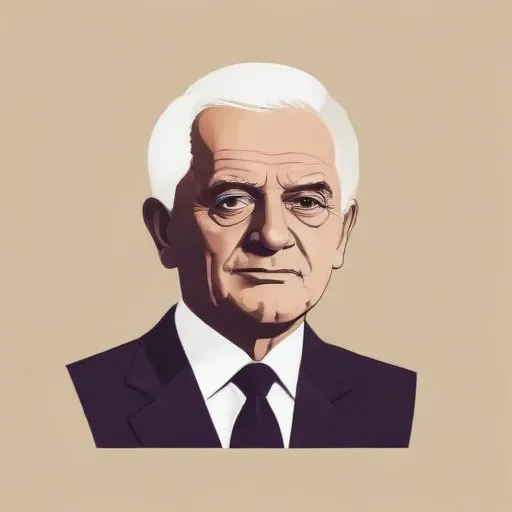
Maltese politician who served as Minister of Justice and Home Affairs, known for his efforts to combat corruption and organized crime.
Giorgio Mitrovich is renowned for his instrumental role in the struggle for freedom of the press in Malta, a fight that culminated in the abolition of press censorship in 1839. As a passionate advocate for free expression, Mitrovich co-authored a petition in 1832 that led to a new constitution, paving the way for a more democratic Malta.
Born on August 27, 1795, in Senglea, Malta, Mitrovich was baptized by Canon Don Salvatore Bonnici a day later. His parents, Saverio Mitrovich and Adeodata née Boldoni, instilled in him a strong sense of justice and morality. Mitrovich's paternal grandfather, also named Giorgio Mitrovich, was a successful privateer from Kotor, who had arrived in Malta in the 1770s, exposing the young Mitrovich to the importance of independence and self-determination.
During Mitrovich's childhood, Malta underwent a period of significant political upheaval. The centuries-long Hospitaller rule ended with a French invasion in 1798, followed by a French occupation, an uprising, and eventually, a British protectorate in 1800. This tumultuous period shaped Mitrovich's worldview and fueled his desire for Maltese autonomy.
In the early years of British rule, the Maltese people had no freedom of expression, with only the Commissariat Department and the Church Missionary Society holding licensed printing presses. Mitrovich, determined to challenge this status quo, traveled to London multiple times to raise awareness about Maltese grievances. His 1835 visit resulted in a Royal Commission recommending the abolition of press censorship, which was eventually implemented in 1839.
Giorgio Mitrovich's unwavering dedication to the cause of freedom of expression has left an indelible mark on Maltese history. His efforts paved the way for a more democratic Malta, where citizens could express themselves freely and participate in the country's governance. Today, Mitrovich is remembered as a champion of liberty and a symbol of Maltese resilience.
92 Years Old
Malta's 7th President, a lawyer-turned-politician, led the country's transition to EU membership and economic growth. He's revered for his statesmanship and vision for a modern Malta.
73 Years Old
The 12th Prime Minister of Malta, serving from 2004 to 2013, is known for his economic reforms and EU membership negotiations. He played a crucial role in Malta's accession to the European Union.
52 Years Old
The 13th Prime Minister of Malta, a prominent figure in Maltese politics, known for his progressive policies and efforts to strengthen the country's economy. He resigned amid controversy surrounding a high-profile murder investigation.
93 Years Old
The 9th Prime Minister of Malta, serving from 1984 to 1987, known for his role in shaping Malta's economy and foreign policy during a period of significant change. He implemented various reforms and strengthened Malta's ties with the European Community.
Born in 1916
A Maltese journalist and politician who served as the 8th Prime Minister of Malta, known for his strong leadership and efforts to modernize the country. He played a key role in Malta's transition to independence from British rule.
