


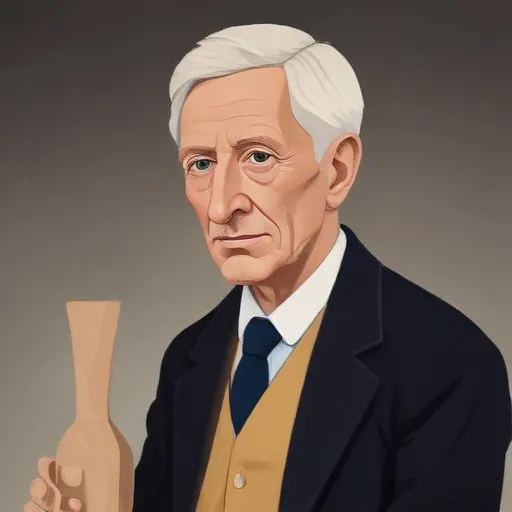
A 20th-century master of still-life painting, capturing the essence of everyday objects in subtle, nuanced colors and compositions. His work continues to inspire artists and designers alike.
Giorgio Morandi was an Italian painter and printmaker renowned for his exquisite still lifes, which showcased his mastery of tonal subtlety in depicting everyday subjects, such as vases, bottles, bowls, flowers, and landscapes. With a career spanning over five decades, Morandi's unique style, characterized by simplicity, elegance, and nuanced color palettes, has made him a revered figure in the world of modern art.
Morandi was born on July 20, 1890, in Bologna, Italy, to Andrea Morandi and Maria Maccaferri. He was the eldest of five sons and three daughters. The family moved to Via Avesella, where Morandi's siblings were born, and later to Via Fondazza after his father's death in 1909. Morandi became the head of the family at a young age and took on the responsibility of supporting his family.
From 1907 to 1913, Morandi studied at the Accademia di Belle Arti di Bologna, where he developed a strong foundation in etching and painting. During his time at the Accademia, he was heavily influenced by the works of Rembrandt, Giotto, Masaccio, and Piero della Francesca.
Morandi's artistic style underwent significant transformations throughout his career. In the early 1910s, he was influenced by the Futurist movement, but soon abandoned it to focus on more subtle and minimalist approaches. The works of Cézanne, Derain, and Picasso also had a profound impact on his artistic style.
During World War I, Morandi's still life paintings became more reduced in their compositional elements and purer in form, revealing his admiration for Cézanne and Henri Le Douanier Rousseau. This period marked the beginning of his unique style, characterized by simplicity, elegance, and a focus on subtle gradations of hue and tone.
Between 1918 and 1922, Morandi practiced metaphysical painting (pittura metafisica), a style characterized by a sense of mystery, ambiguity, and intellectualism. This period marked a significant shift in his artistic style, as he began to focus more on the emotional and philosophical aspects of his work.
After 1922, Morandi's style became even more refined and subtle, with a greater emphasis on tone, color, and texture. His paintings from this period are characterized by a sense of calmness, serenity, and contemplation.
Giorgio Morandi's unique style and contributions to modern art have had a lasting impact on the art world. His work has influenced generations of artists, including Ellsworth Kelly, Agnes Martin, and Cy Twombly, among others.
Today, Morandi's paintings are held in high esteem and can be found in some of the world's most prominent museums, including the Museum of Modern Art in New York, the Tate Modern in London, and the Galleria Nazionale d'Arte Moderna in Rome.
Giorgio Morandi's legacy extends beyond his artistic contributions. He remains an inspiration to artists, art enthusiasts, and anyone who appreciates the beauty of simplicity and elegance.
Born in 1881
A pioneering artist who transformed modern art with pioneering Cubist works, creating a new visual language that continues to inspire and influence art, design, and culture.
Born in 1904
A renowned surrealist master of bizarre, dream-like paintings and sculptures that blur reality and fantasy, known for iconic works like "The Persistence of Memory" and "The Elephants".
Born in 1898
A Belgian surrealist painter who challenged perceptions by depicting everyday objects in unexpected contexts, creating thought-provoking and witty visual paradoxes.
Born in 1893
A renowned Spanish artist, famous for his vibrant, dreamlike paintings and sculptures that blended abstraction and surrealism, creating a unique visual language. His works often featured bold colors, biomorphic forms, and a sense of playfulness.
Born in 1891
A pioneering figure in Surrealism, creating dreamlike, fantastical works that blurred reality and the subconscious, influencing generations of artists.
Born in 1896
French poet and author who founded Surrealism, a cultural movement that explored the subconscious and the world of dreams. He wrote novels, poems, and essays that continue to influence art and literature today.
Born in 1900
A surrealist painter who created dreamlike, fantastical landscapes with melting objects and eerie atmospheres, blurring the line between reality and fantasy.
Born in 1890
A pioneer of avant-garde photography, this artist experimented with techniques like solarization and rayography, creating surreal, dreamlike images that blurred the line between art and photography.
