


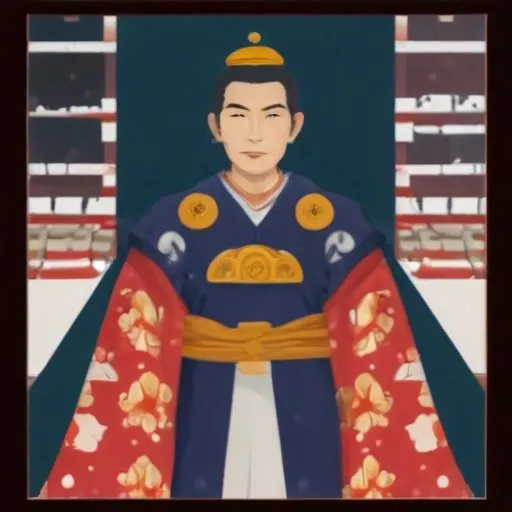
The 63rd emperor of Japan, who ruled from 1045 to 1068, is most known for his efforts to consolidate imperial power and reform the government, as well as his patronage of Buddhism.
Emperor GoReizei, the 70th emperor of Japan, is known for his remarkable reign that spanned over two decades, from 1045 to 1068. During his rule, he navigated the country through a series of challenges, including a major rebellion, and left an indelible mark on Japanese history.
Born on August 28, 1025, GoReizei's personal name was Chikahitoshinn, and he was the eldest son of Emperor GoSuzaku. His mother, Fujiwara no Kishi, was the daughter of the powerful Fujiwara no Michinaga. GoReizei's ascension to the throne came in 1045, following his father's abdication, and he formally took the throne on the same day.
The most significant event during GoReizei's reign was the Zenkunen War, a rebellion instigated by Abe no Sadat and Munet in 1051. In response, Minamoto no Yoriyoshi was appointed governor of Mutsu and granted the title of chinjufu shgun to quell the uprising. This marked a significant turning point in Japanese history, as Yoriyoshi would go on to play a crucial role in maintaining peace in the north.
Despite having three empresses, GoReizei failed to produce an heir, leaving no direct successors to the throne. He died on May 22, 1068, at the age of 44, bringing an end to his remarkable reign. GoReizei's legacy lies in his ability to steer Japan through turbulent times, and his reign is often viewed as a period of relative stability in Japanese history.
GoReizei's reign coincided with the Heian period, a time of significant cultural and artistic development in Japan. His reign is often compared to that of his contemporaries, including Emperor GoSuzaku and Emperor GoSanjo. While his reign was marked by challenges, GoReizei's ability to navigate these difficulties and maintain stability sets him apart from his predecessors.
Emperor GoReizei's remarkable reign serves as a testament to his strength and resilience, and his legacy continues to shape Japanese history to this day.
