


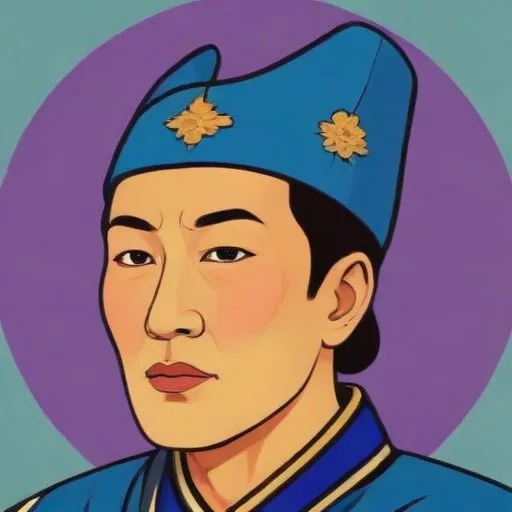
The 14th-century Korean monarch who oversaw the creation of the Jikji, the world's oldest surviving movable metal print book, and implemented significant reforms to stabilize the kingdom.
Gongmin of Goryeo, also known as Bayan Temr, is renowned for his bold efforts to reform the Goryeo government and reclaim Korean independence from the declining Mongol Yuan dynasty. As the 31st ruler of Goryeo, he reigned from 1351 to 1374, leaving a lasting legacy in the annals of Korean history.
Gongmin was born on May 23, 1330, as the second son of King Chungsuk. As was customary for prospective Korean rulers, he was sent to the Yuan court in 1341, where he spent many years as a de facto hostage. During this time, he married a Mongolian princess, Queen Indeok, solidifying the ties between the two nations.
As the Yuan dynasty began to crumble in the mid-14th century, Gongmin saw an opportunity to break free from Mongol overlordship and reform the Goryeo government. He swiftly removed pro-Mongol aristocrats and military officers from their positions, sparking a failed coup attempt by the deposed officials.
One of his most significant accomplishments was the recapture of the northern provinces of Korea, which had been annexed by the Mongols during the 1250s-1270s. In 1356, General Yi Snggye and his son, Yi Chachun, defected from the Mongols and joined the Goryeo army, contributing to the successful reclamation of the provinces. This campaign was further bolstered by Generals Yi Snggye and Ji Yongsu's campaign into Liaoyang.
Gongmin's reign also saw significant land reform, as the land-grant system had broken down under Mongol rule. He implemented policies to redistribute land, addressing the issue of unequal land holdings and favoritism towards Mongol-backed officials.
Gongmin's vision for an independent Korea and his efforts to reforms the government have left a lasting impact on Korean history. His reign marked a significant turning point in the country's struggle for sovereignty, paving the way for future generations to build upon.
Gongmin's reign was marked by the decline of the Mongol Yuan dynasty and the rise of the Ming dynasty in China. His efforts to reform the government and reclaim Korean independence set the stage for future generations to build upon, ultimately contributing to the development of the Joseon dynasty.
Gongmin's legacy extends beyond his reforms, as he demonstrated remarkable resilience and adaptability in the face of adversity. His commitment to independence and sovereignty has inspired generations of Koreans, cementing his place as one of the most revered figures in Korean history.
Born in 1397
Creator of the Korean alphabet, Hangul, and a visionary leader who promoted education, science, and the arts, transforming Korea into a cultural and economic powerhouse.
Born in 1694
The 18th-century Korean king who oversaw a golden age of cultural and economic prosperity, and is revered for his wise and just rule. He's also known for his efforts to reform the government and improve the lives of common people.
Born in 1694
The 18th-century Korean king who oversaw a golden age of cultural and economic prosperity, and is revered for his wise and just rule. He's also known for his efforts to reform the government and improve the lives of common people.
95 Years Old
A South Korean general and politician who served as the 5th President of South Korea, known for his military coup and subsequent authoritarian rule. He's infamous for his role in the Gwangju Democratization Movement's brutal suppression.
93 Years Old
South Korea's first democratically elected president, known for his role in the country's transition to democracy and his key role in the 1988 Seoul Olympics. He's also infamous for his involvement in a military coup and human rights abuses.
