


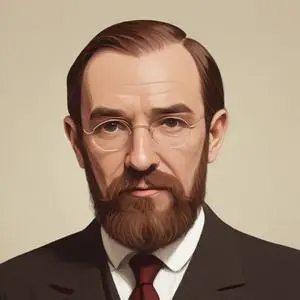
Developed a formal system of logic and introduced modern mathematical notation, laying the groundwork for modern logic, mathematics, and computer science.
Gottlob Frege, a German philosopher, logician, and mathematician, is widely regarded as the father of analytic philosophy, making significant contributions to the fields of logic, mathematics, and philosophy of language. He is best known for his groundbreaking work in developing modern logic and his influential philosophical papers on sense and reference, which have had a profound impact on the development of modern philosophy.
Born on November 8, 1848, in Wismar, Mecklenburg-Schwerin (now part of Mecklenburg-Vorpommern), Frege's early life was marked by tragedy, with his father, Carl Alexander Frege, passing away in 1866. His mother, Auguste Wilhelmine Sophie Frege, took over as the headmistress of the school his father founded, providing a stable and intellectual environment for Frege's growth.
Frege's academic career began at the University of Jena, where he earned his Ph.D. in mathematics in 1873. He went on to become a mathematics professor at the university, a position he held until his retirement in 1918. During this period, he published several influential works, including:
Despite being largely ignored during his lifetime, Frege's work was rediscovered and popularized by philosophers such as Giuseppe Peano, Bertrand Russell, and Ludwig Wittgenstein, who were heavily influenced by his ideas. Today, Frege is widely regarded as one of the most profound philosophers of mathematics, and his work continues to influence fields such as philosophy, logic, mathematics, and computer science.
Frege's philosophical contributions can be summarized as follows:
Frege's legacy is that of a visionary philosopher who laid the foundations for modern philosophy, logic, and mathematics. His work continues to influence contemporary philosophy, and his ideas remain a subject of ongoing debate and discussion.
Born in 1872
A renowned thinker who made significant contributions to mathematics, philosophy, and social commentary, known for his influential writings on logic, ethics, and politics. He's a prominent figure in shaping modern intellectual thought.
Born in 1889
A philosopher who challenged traditional philosophy by emphasizing the importance of language and its limits, and is famous for his philosophical ideas on logic, reality, and the nature of meaning.
Born in 1906
A groundbreaking logician and philosopher who shook the foundations of mathematics with his incompleteness theorems, proving that no formal system can be both complete and consistent.
Born in 1862
A renowned mathematician and academic who developed infinite-dimensional vector spaces and laid the foundation for quantum mechanics and relativity. He's also famous for his 23 unsolved math problems that shaped 20th-century mathematics.
Born in 1845
Developed set theory, introducing infinite sets and cardinal numbers, revolutionizing mathematics and philosophy.
Born in 1831
Developed a rigorous definition of real numbers and introduced the concept of Dedekind cuts, revolutionizing mathematics and laying the foundation for modern analysis. His work also explored the nature of infinity and the foundations of mathematics.
Born in 1858
Developed a formal system of mathematical logic and notation, and created a new approach to mathematical rigor, influencing the development of modern mathematics.
