


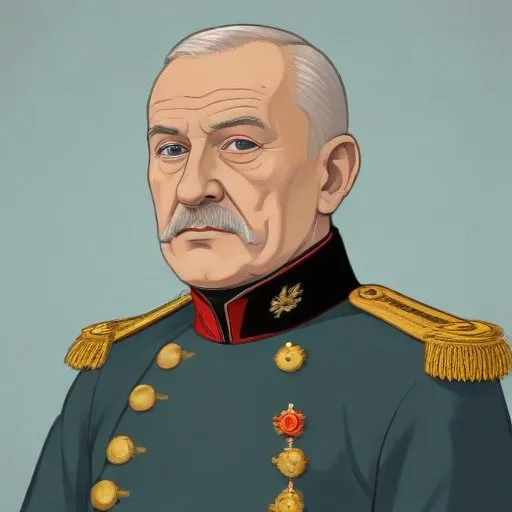
A prominent Estonian-Russian military leader and geologist who explored and mapped the Caucasus region, making significant contributions to the field of geology. His work greatly advanced the understanding of the region's natural resources and geological structure.
Gregor von Helmersen was a renowned Baltic German geologist who left an indelible mark on Russia's geological landscape. Throughout his illustrious career, he made groundbreaking contributions to the field of geology, authoring numerous memoirs on Russia's geology, particularly on coal and mineral deposits.
Von Helmersen was born on October 11, 1803, in Duckershof, Livonia (now in Estonia). He attended boarding school in St. Petersburg and later graduated from the University of Dorpat in 1825. His academic pursuits took him to the universities of Berlin, Heidelberg, and Bonn, where he listened to lectures and expanded his knowledge in geology.
In 1835, von Helmersen joined the Corps of Mining Engineers and later became a professor of geology at the Mining Institute in Saint Petersburg, where he also served as director. This marked the beginning of a remarkable career that spanned several decades.
In 1839, von Helmersen, along with Karl Ernst von Baer, founded the first serial natural scientific publication in Russia, titled Beiträge zur Kenntniss des Russischen Reiches. This monumental achievement cemented his position as a leading figure in Russian geology.
In 1850, von Helmersen was elected an academician of the Russian Academy of Sciences in St. Petersburg, a testament to his outstanding contributions to the field. In 1882, he founded and became the first head of the Russian Geological Committee, further solidifying his legacy.
Von Helmersen's most significant achievement lies in his meticulous study of Russia's geology. He authored numerous memoirs on the subject, shedding light on the country's coal and mineral deposits. His work provided invaluable insights into Russia's natural resources, shaping the country's economic and industrial development.
His publications, including Studien über die Wanderblöcke und die Diluvialgebilde Russlands (1869 and 1882), remain seminal works in the field of Russian geology. Many of his memoirs were published by the Imperial Academy of Sciences at Saint Petersburg, ensuring their widespread dissemination and impact.
Gregor von Helmersen's contributions to Russian geology have been immense. He not only expanded the country's understanding of its natural resources but also inspired future generations of geologists. Through his tireless efforts, he laid the foundation for Russia's geological exploration and development, solidifying his position as a pioneer in the field.
Von Helmersen's remarkable career serves as a testament to his unwavering dedication to the pursuit of knowledge and his unrelenting passion for geology. As we reflect on his life and achievements, we are reminded of the profound impact one individual can have on the scientific community.
Gregor von Helmersen's remarkable journey serves as a beacon of inspiration for aspiring geologists and scientists, reminding us of the power of dedication, perseverance, and innovation in shaping our understanding of the world around us.
Born in 1827
A Russian geographer and statistician who mapped and studied the geography of Central Asia, making significant contributions to the field of geography and cartography. He's also credited with establishing the Russian Geographical Society.
Born in 1839
A Russian geographer and explorer who mapped much of Central Asia, discovering new species and charting unexplored territories. He's considered the "Russian Marco Polo" for his extensive travels and contributions to the field of geography.
