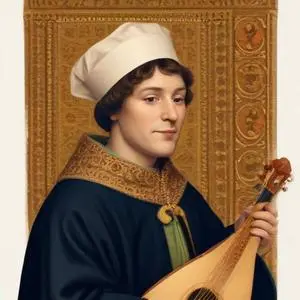
Guillaume Dufay

Guillaume Dufay

Guillaume Dufay was born on August 5th, 1397

Full Name: Guillaume Dufay
Place of Birth: Beersel, Belgium
Zodiac Sign: Unknown
Nationality: Belgian-Italian
Profession: Composer and theorist
Notable Works: Nuper rosarum flores
Influences: John Dunstaple
Died: November 27, 1474

A renowned composer and theorist of the early Renaissance, known for his innovative and influential works that bridged the medieval and Renaissance styles. He was a master of the Burgundian Court and wrote music for royal courts and churches.

Written by: Isabel Sanchez Isabel Sanchez

The Harmonious Legacy of Guillaume Dufay

Guillaume Dufay, the renowned Franco-Flemish composer, left an indelible mark on the world of music with his innovative and melodious compositions. He is particularly celebrated for his role in shaping the Burgundian school of music, a distinctive style that characterized the early Renaissance period.

A Life of Melody

Born around 1397 in Beersel, Belgium, Dufay received his early education from the Church of St. Gudula in Brussels. His exceptional talent in music was evident from a young age, and he went on to become a singing boy at the cathedral of Cambrai.

The Early Years

Dufay's early compositions reflect the influence of his contemporaries, such as John Dunstaple and Binchois. However, he soon developed a unique style that blended the complexity of the Ars subtilior with the elegance of the Burgundian court.

Major Works and Innovations

Dufay's contributions to music are multifaceted and far-reaching. Some of his notable works include:

Influence on Modern Society

Dufay's music had a profound impact on the cultural landscape of Europe during the Renaissance. His works inspired a new generation of composers, including Josquin des Prez and Johannes Ockeghem, who further developed the Burgundian style.

Personal Milestones and Key Life Events

In 1420, Dufay became a priest and began his association with the Malatesta family in Rimini, Italy. This connection led to his involvement in the Council of Basel, where he composed music for the court of Pope Eugene IV.

Philosophical Contributions and Beliefs

As a composer, Dufay's music reflects his deep understanding of humanism and the cultural values of the Renaissance. His works often express a sense of spirituality and introspection, revealing his profound connection to the divine.

Legacy and Impact

Guillaume Dufay's legacy extends far beyond his compositions. He played a crucial role in shaping the course of Western classical music, influencing generations of composers and musicians. Today, his works continue to inspire and delight audiences around the world.

In conclusion, Guillaume Dufay's remarkable life and works have left an indelible mark on the world of music. His innovative spirit, coupled with his mastery of harmony and counterpoint, has made him one of the most celebrated composers of the early Renaissance.

Timeline
1397
Born in Beersel
Guillaume Dufay was born in Beersel, Duchy of Brabant, around 1397.
1419
Became Choirboy
Dufay became a choirboy at the Cathedral of Cambrai, where he began his musical training.
1420
Went to Italy
He traveled to Italy, where he studied music and became familiar with the works of Italian composers.
1450
Returned to Cambrai
Dufay returned to Cambrai and became the maistre de chapelle at the Cathedral, a position he held until his death.
1474
Died in Cambrai
Guillaume Dufay passed away on November 27, 1474, in Cambrai, Habsburg Netherlands.
Guillaume Dufay

Guillaume Dufay Quiz

What musical style did Guillaume Dufay's works bridge?

Score: 0/5
FAQ
What was the significance of Guillaume Dufay in the development of Renaissance music?
Guillaume Dufay was a leading composer of the early Renaissance, known for his mastery of complex musical forms and his role in shaping the development of polyphonic music.
What were the major works of Guillaume Dufay?
Guillaume Dufays major works include his masses, motets, and chansons, which showcase his innovative use of harmony and counterpoint, and demonstrate his influence on the development of Renaissance music.
How did Guillaume Dufays music reflect the cultural climate of the Renaissance?
Guillaume Dufays music reflected the cultural climate of the Renaissance, marked by a renewed interest in classical learning, a focus on humanism, and a desire for beauty and elegance in art and architecture.
What was the impact of Guillaume Dufays music on future generations?
Guillaume Dufays music had a significant impact on future generations of composers, influencing the development of polyphonic music and paving the way for the emergence of Renaissance masters such as Josquin des Prez.
What is Guillaume Dufays legacy in the history of music?
Guillaume Dufays legacy in the history of music is as a pioneer of Renaissance polyphony, a master of complex musical forms, and a key figure in the transition from medieval to Renaissance music.