


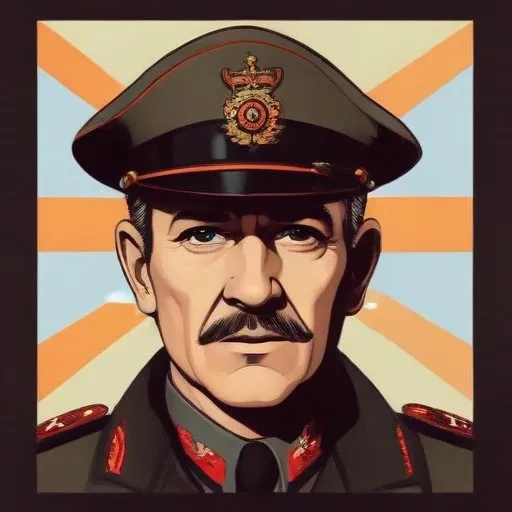
A senior officer who played a crucial role in the Allied victory in World War II, leading Canadian forces in key battles like D-Day and the Normandy campaign.
Guy Simonds, a senior Canadian Army officer, is widely regarded as one of the most accomplished generals of World War II. His exceptional leadership and strategic prowess earned him recognition from distinguished military historians and commanders, including Sir Max Hastings and Field Marshal Sir Bernard Montgomery.
Simonds was born on April 23, 1903, in Ixworth, near Bury St Edmunds, Suffolk, England, into a military family with a rich history of service. His great-grandfather had served in the Honourable East India Company, his grandfather was a major-general in the British Indian Army, and his father was an officer in the British Army's Royal Regiment of Artillery.
Simonds' military career spanned several decades, but it was during World War II that he truly made his mark. Initially serving as a staff officer, he quickly rose through the ranks, commanding the 1st Canadian Infantry Division in Sicily and Italy from July 1943 to January 1944. His exceptional leadership during this period earned him recognition as one of the most capable Canadian generals of the war.
In June 1944, Simonds took command of II Canadian Corps during the pivotal Battle of Normandy. His tactical genius and ability to adapt to rapidly changing circumstances played a crucial role in the Allied victory. He continued to lead II Canadian Corps throughout the subsequent campaign in Western Europe, eventually taking temporary command of the First Canadian Army during the Battle of the Scheldt.
After the war, Simonds attended the Imperial Defence College in London, initially as a student and later as an instructor. He then returned to Canada to command the National Defence College. In 1951, at the age of 48, he was appointed Chief of the General Staff, the head of the Canadian Army, a position he held for four years, including during the Korean War.
Historian J.L. Granatstein describes Simonds as a commander who "owed his success wholly to his own abilities and efforts, and those of the men who served under him." Simonds' remarkable career serves as a testament to his exceptional leadership, strategic thinking, and commitment to his country. His legacy continues to inspire and influence military leaders to this day.
"No Canadian commander rose higher and faster in the Second World War, and none did as well in action." - Historian J.L. Granatstein
Simonds was known for his dry sense of humor and humility. When asked about his success, he would often deflect attention, crediting his troops and staff for their hard work and dedication.
Guy Simonds passed away on May 15, 1974, leaving behind a legacy of exceptional leadership and military prowess. His remarkable career continues to inspire and educate military historians, strategists, and leaders around the world.
Born in 1871
Prolific writer of historical novels and adventure stories, also a talented landscape painter.
Born in 1890
Led the Allied forces to victory in World War II and later served as President, maintaining peace and prosperity during the Cold War era. He's known for his strategic leadership and diplomatic skills.
Born in 1885
A renowned military leader who played a crucial role in World War II, particularly in the Allied victory in Europe, known for his bold tactics and unapologetic style.
