


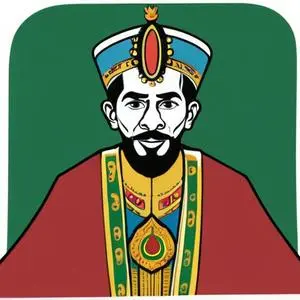
The last emperor of Ethiopia, who led the country through a period of modernization and was a symbol of African independence, and is also revered as a deity by the Rastafari movement.
Haile Selassie, Ethiopia's 225th emperor, is renowned for his tireless efforts to modernize his country, promote pan-Africanism, and assert Ethiopia's sovereignty on the global stage. As a defining figure in modern Ethiopian history, he is revered by millions, including followers of the Rastafari movement, who regard him as a messianic figure.
Born Tafari Makonnen on July 23, 1892, in Ejersa Goro, Ethiopia, Haile Selassie was a member of the Solomonic dynasty, which claims to trace its lineage to Emperor Menelik I, a legendary figure believed to be the son of King Solomon and the Queen of Sheba. After his father's death, Selassie's cousin, Empress Zewditu, appointed him Regent Plenipotentiary, a position that paved the way for his ascension to the throne.
Upon becoming emperor in 1930, Selassie embarked on a program of modernization, introducing Ethiopia's first written constitution in 1931 and abolishing slavery in 1932. He also established a new capital, Addis Ababa, and invested heavily in education, infrastructure, and healthcare. His efforts aimed to transform Ethiopia into a modern, constitutional monarchy.
In 1935, Italy, under fascist dictator Benito Mussolini, invaded Ethiopia, prompting Selassie to lead the resistance. Despite his valiant efforts, the Ethiopian army was no match for the Italian forces, and Selassie was forced into exile in the United Kingdom. During his five-year exile, he continued to advocate for Ethiopia's sovereignty, appealing to the League of Nations and rallying international support.
After his return to Ethiopia in 1941, Selassie played a key role in the formation of the United Nations, becoming one of its charter members. He also presided over the establishment of the Organisation of African Unity (OAU) in 1963, serving as its first chairman. Through the OAU, he promoted pan-African unity, economic cooperation, and decolonization across the continent.
Selassie's legacy is complex and multifaceted. While he is revered for his modernization efforts, his leadership was also marked by authoritarian tendencies and human rights abuses. His dissolution of the Ethiopian-Eritrean federation and annexation of Eritrea as a province in 1962 remain contentious issues.
Selassie was a devout Ethiopian Orthodox Christian and believed in the unity of Africa and the importance of African self-determination. He also promoted a philosophy of unity, justice, and equality, which resonated with people across the continent.
"It is us today. It will be you tomorrow." - Haile Selassie, speaking about the importance of international cooperation and solidarity.
Selassie's legacy extends beyond politics, inspiring a global movement of Rastafarians who revere him as the Lion of Judah. His image has been immortalized in music, art, and literature, with notable references in songs by Bob Marley, The Wailers, and Peter Tosh.
Haile Selassie's life and reign were marked by significant global events, including World War II, decolonization, and the Cold War. As a symbol of African independence and unity, his legacy continues to inspire generations across the continent and beyond.
