


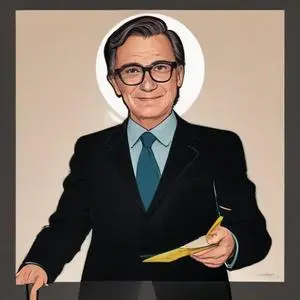
A renowned psychologist and theorist who developed the three-factor model of personality, proposing that personality traits can be categorized into extraversion, neuroticism, and psychoticism.
Known for his groundbreaking work on intelligence and personality, Hans Eysenck was a German-born British psychologist who left an indelible mark on the field of psychology. His research purported to show that certain personality types had an elevated risk of cancer and heart disease, making him a household name in the scientific community.
Born on March 4, 1916, in Berlin, Germany, Eysenck's life was marked by turmoil and tragedy. His mother, Helga Molander, was a Silesian-born film star, and his father, Eduard Anton Eysenck, was an actor and nightclub entertainer. Eysenck was brought up by his maternal grandmother, a Jewish convert to Catholicism, who was later deported and died in a concentration camp.
Eysenck's research focused on the intersection of personality, intelligence, and health. He proposed the PEN (Psychoticism, Extraversion, and Neuroticism) model of personality, which posits that personality can be understood through three supertraits. His work also explored the relationship between personality and disease, claiming that certain personality types were more prone to cancer and heart disease.
Eysenck's claims about IQ scores and race, first published in 1971, sparked controversy and debate. He believed that IQ scores were influenced by genetic differences between racial groups, a notion that has since been discredited by subsequent research. Despite the controversy, Eysenck's work continues to influence modern society, with his theories on personality and intelligence still widely discussed and debated.
Eysenck's philosophical contributions centered around the concept of heritability, which he believed played a significant role in shaping human behavior and intelligence. He argued that genetic factors were more important than environmental factors in determining human traits, a stance that has been both praised and criticized by his peers.
Eysenck's research and theories have been subject to intense scrutiny and criticism. Scholars have identified errors and suspected data manipulation in his work, leading to the retraction of several papers and statements of concern from scientific journals. Despite the controversy, Eysenck remains one of the most frequently cited psychologists in the scientific literature.
Love him or hate him, Hans Eysenck's contributions to psychology cannot be ignored. His work continues to influence modern research, and his theories remains a topic of debate among psychologists and scholars. Despite the controversy surrounding his research, Eysenck's legacy serves as a reminder of the importance of rigorous scientific inquiry and critical thinking.
Born in 1856
Pioneering psychoanalyst who developed theories on the subconscious mind, childhood experiences, and the structure of personality, revolutionizing our understanding of human behavior and psychology.
Born in 1875
Developed the concept of collective unconscious and archetypes, and founded analytical psychology, which emphasizes the integration of opposites and the process of individuation.
Born in 1904
Developed the theory of operant conditioning, which explores the relationship between behavior and environment, and invented the "Skinner box" to study learning and behavior.
Born in 1896
Developed groundbreaking theories on child cognitive development and learning, emphasizing active discovery and hands-on experience. His work has shaped modern education and parenting practices.
Born in 1900
A German psychologist and sociologist who developed the concept of "social character" and explored the relationship between psychology and society, known for his humanistic and socialist approach.
Born in 1925
Developed the theory of social learning, which suggests that people learn new behaviors by observing and imitating others, and is known for his Bobo doll experiment.
Born in 1908
Developed the Hierarchy of Needs, a pyramid-shaped model that prioritizes human needs, from basic physiological needs to self-actualization and personal growth. His work focuses on human motivation and the pursuit of happiness.
Born in 1902
Developed the theory of psychosocial development, which proposes that individuals go through eight stages of development from infancy to old age, each with its own unique challenges and opportunities. His work has had a significant impact on our understanding of human development and identity formation.
