


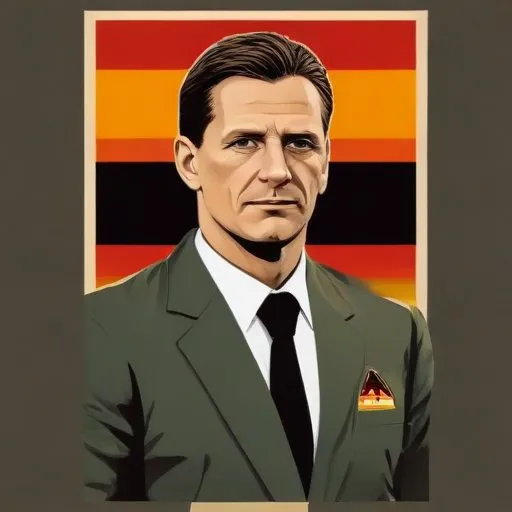
Goalkeeper and manager who played for Cologne and the German national team, known for his aggressive playing style and infamous incident in the 1982 World Cup semifinal against France.
Harald Schumacher is a name that resonates with football fans worldwide, synonymous with controversy, tenacity, and an unwavering commitment to the beautiful game. As the German goalkeeper, he etched his name in history with a mercurial blend of brilliance and brutality, earning both admiration and notoriety in equal measure.
Schumacher's professional career spanned over a decade, with stints at 1. FC Köln, FSV Frankfurt, and FC Schalke 04. His most notable achievement was being part of the West German national team that finished as runners-up in the 1982 World Cup. However, it was his antics during the 1982 semi-final match against France that would forever tarnish his reputation.
In a notorious incident, Schumacher clashed with French defender Patrick Battiston, leaving him unconscious and with a broken vertebra. The brutal tackle sparked outrage, and Schumacher's refusal to apologize sparked a firestorm of controversy. The incident became a defining moment in his career, casting a long shadow over his accomplishments.
Schumacher's on-field persona was often at odds with his introspective nature. He was known for his philosophical musings, often speaking about the importance of mental toughness and the psychological aspects of the game. His autobiography, "Anpfiff" (Kick-Off), offered a glimpse into his thoughts on the sport, revealing a more nuanced and complex individual beyond the public persona.
Schumacher's impact on modern society extends beyond the football pitch. His controversial actions sparked a broader discussion about sportsmanship, ethics, and the limits of competition. His legacy serves as a reminder that even the most skilled athletes must operate within the boundaries of fair play and respect for their opponents.
Schumacher's actions on the pitch often overshadowed his accomplishments, earning him the moniker "The Monster of Cologne." The Battiston incident, in particular, has become a symbol of his reputation as a ruthless and unsportsmanlike player.
"I didn't mean to hurt Battiston, but I had to defend my goal." – Harald Schumacher, on the infamous incident
Schumacher's legacy is complex, a mix of brilliance and brutality. While his on-field achievements are undeniable, they are forever tainted by the controversy surrounding his actions. As a cultural icon, he serves as a reminder of the fine line between competitiveness and sportsmanship.
Schumacher's personal relationships were often as tumultuous as his on-field persona. His marriage to German actress Ehefrau ended in divorce, and he later became embroiled in a public feud with his former coach, Rinus Michels.
Today, Schumacher remains a polarizing figure, his name evoking strong emotions in those who remember his playing days. Love him or loathe him, Harald Schumacher's impact on the world of football is undeniable, a testament to the power of controversy and the enduring legacy of a complicated and fascinating individual.
80 Years Old
A German football legend who won the World Cup as both a player and manager, known for his innovative style and leadership on the pitch.
71 Years Old
A German politician and businessman who served as the Minister of Food, Agriculture, and Consumer Protection from 2001 to 2005, known for his efforts to promote sustainable agriculture and animal welfare.
82 Years Old
Legendary German goalkeeper and manager, known for his incredible reflexes and shot-stopping ability, earning him the nickname "Die Katze von Anzing" (The Cat from Anzing).
74 Years Old
A legendary German midfielder who won the 1974 World Cup and is renowned for his attacking prowess and iconic hairstyle. He's a football legend and cultural icon of the 1970s.
62 Years Old
A German football legend who won the 1990 World Cup as a player and later managed the US national team, known for his charismatic leadership and attacking style.
