


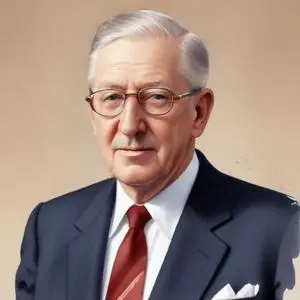
A British politician who served as Prime Minister from 1957 to 1963, known for leading the country through a period of economic prosperity and decolonization.
Harold Macmillan, the 1st Earl of Stockton, is renowned for his adept leadership as the Prime Minister of the United Kingdom from 1957 to 1963, earning him the esteemed nickname "Supermac." This pragmatic statesman navigated the tumultuous waters of post-war Britain, piloting the nation through a period of unprecedented prosperity and growth.
Macmillan was born on February 10, 1894, in London, England. His life took a dramatic turn during World War I, where he served as an infantry officer and suffered severe injuries. The pain and partial immobility he endured for the rest of his life only seemed to fuel his determination and resilience.
Following the war, Macmillan joined his family's esteemed book publishing business before entering Parliament in 1924. After losing his seat in 1929, he regained it in 1931 and soon became an outspoken critic of the high unemployment rates in Stockton-on-Tees. During World War II, Macmillan rose to prominence as a protégé of Prime Minister Winston Churchill, further cementing his position in British politics.
Macmillan's premiership, which spanned from 1957 to 1963, was marked by a commitment to the post-war consensus and the One Nation Tory tradition. He believed in the necessity of a mixed economy, with a blend of nationalized industries and strong trade unions. Macmillan's Keynesian strategy of deficit spending aimed to maintain demand and drive economic growth. His policies led to a period of low unemployment and high, albeit uneven, growth, earning him the reputation as the champion of a more affluent Britain.
Macmillan's tenure as Prime Minister also saw significant international developments. He worked diligently to rebuild the Special Relationship with the United States, which had been strained following the Suez Crisis. His leadership during this period ensured a harmonious relationship between the two nations, paving the way for future cooperation.
Macmillan's lasting legacy extends beyond his time in office. He is remembered for his wit, pragmatism, and unflappability in the face of adversity. As a testament to his enduring influence, his phrase "You've never had it so good" has become synonymous with the optimism and prosperity of 1950s Britain.
Macmillan's remarkable life, marked by courage, resilience, and visionary leadership, continues to inspire generations of politicians and statesmen. His indelible mark on British history is a testament to the power of effective leadership and diplomacy.
Born in 1871
Prolific writer of historical novels and adventure stories, also a talented landscape painter.
Born in 1897
A British politician who served as Prime Minister from 1955 to 1957, known for his role in the Suez Crisis and his diplomatic efforts during the Cold War.
Born in 1903
A British aristocrat who served as Prime Minister from 1963 to 1964, known for his brief tenure and aristocratic background.
Born in 1885
Won the 1952 Olympic Games marathon in Helsinki, Finland, and held the world record in the marathon from 1952 to 1953.
Born in 1916
The Prime Minister who led the UK into the European Economic Community (EEC) and navigated the country through a period of economic and industrial turmoil. He's also known for his diplomatic efforts, particularly in regards to the Cold War.
Born in 1912
A British politician who served as Prime Minister from 1976 to 1979, known for his efforts to stabilize the economy and navigate the country through a period of industrial unrest.
Born in 1925
The first female Prime Minister of the United Kingdom, serving from 1979 to 1990, known for her conservative policies and leadership during the Falklands War.
73 Years Old
The former Prime Minister of the United Kingdom who led the country through a transformative period, including the Iraq War, and is known for his charismatic leadership and controversial decisions.
