


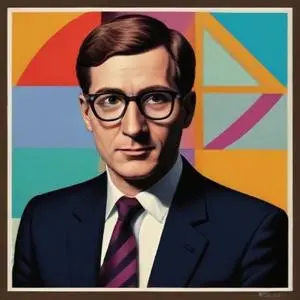
A renowned mathematician and geometer who made significant contributions to the field of geometry, particularly in the areas of polytopes and non-Euclidean geometry. His work has had a lasting impact on mathematics, art, and architecture.
Renowned for his groundbreaking contributions to the field of geometry, Harold Scott MacDonald Coxeter is considered one of the greatest geometers of the 20th century. His work has had a profound impact on the understanding of geometric shapes, symmetries, and structures, earning him a permanent place in the annals of mathematical history.
Born on February 9, 1907, in Kensington, England, Coxeter was surrounded by creativity and talent from a young age. His father, Harold Samuel Coxeter, was a sculptor and baritone singer, while his mother, Lucy Gee Coxeter, was a portrait and landscape painter who had attended the Royal Academy of Arts.
Coxeter's love for mathematics was ignited early, and he went on to study at King Alfred School, London, and St George's School, Harpenden. He was accepted at King's College, Cambridge, in 1925, where he delved deeper into the world of mathematics.
Coxeter's work spanned over 60 years, during which he made significant contributions to various areas of geometry, including:
Coxeter's contributions to mathematics were recognized with numerous awards and honors, including:
Beyond his mathematical pursuits, Coxeter was an accomplished pianist and composer, believing that music and mathematics were intimately related. He outlined his ideas in a 1962 article on "Music and Mathematics" in the Canadian Music Journal.
Coxeter's love for geometry extended beyond mathematics. He was fascinated by the geometric patterns found in nature and art, often finding inspiration in the works of artists like M.C. Escher.
Harold Scott MacDonald Coxeter's work has had a profound impact on various fields, including:
As a testament to his legacy, many concepts in geometry and group theory bear his name, ensuring that his work will continue to inspire future generations of mathematicians and artists alike.
Born in 1914
Prolific writer and puzzle enthusiast who popularized mathematics and science through engaging books and columns, making complex concepts accessible to a broad audience.
88 Years Old
Pioneering computer scientist and mathematician who wrote the multi-volume work "The Art of Computer Programming" and developed the TeX typesetting system. Known for his contributions to algorithms, programming languages, and typography.
73 Years Old
Proved Fermat's Last Theorem, a problem that went unsolved for over 350 years, and made significant contributions to number theory. His work has far-reaching implications for mathematics and cryptography.
Born in 1862
A renowned mathematician and academic who developed infinite-dimensional vector spaces and laid the foundation for quantum mechanics and relativity. He's also famous for his 23 unsolved math problems that shaped 20th-century mathematics.
Born in 1882
A pioneering mathematician and physicist who revolutionized abstract algebra and made groundbreaking contributions to modern physics, particularly in the development of Einstein's theory of general relativity.
