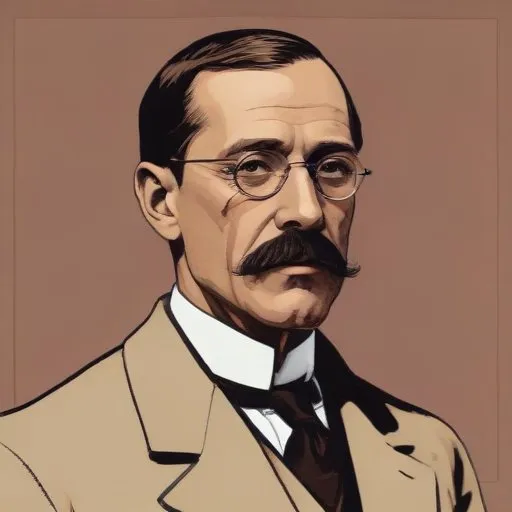
Hawley Harvey Crippen: The Infamous Homeopath and Murderer
A Notorious Name in History
Hawley Harvey Crippen is notoriously known as the first criminal to be captured with the aid of wireless telegraphy, and, more gruesomely, for the murder of his wife, Cora Henrietta Crippen. His name sends shivers down the spine, evoking images of a bygone era when justice was sought through innovative means.
The Early Life of a Homeopath
Born on September 11, 1862, in Coldwater, Michigan, Crippen was the only surviving child of Andresse Skinner and Myron Augustus Crippen, a merchant. He pursued his education in homeopathy, graduating from the Cleveland Homeopathic Medical College in 1884. After the untimely death of his first wife, Charlotte Jane, in 1892, Crippen entrusted his parents with the care of his son, Hawley Otto.
A Career in Homeopathy and Patent Medicines
Crippen started practicing homeopathy in New York City, but his medical qualifications from the United States were not sufficient to allow him to practice as a doctor in the United Kingdom. Instead, he worked as a distributor of patent medicines, initially for prominent homeopath James M. Munyon, and later for other companies. In 1900, he hired Ethel Le Neve, a young typist, at the Drouet Institute for the Deaf, where he worked as a manager. Unbeknownst to many, an illicit affair was brewing between Crippen and Le Neve.
A Life of Deceit and Murder
By 1905, Crippen's relationship with Ethel had intensified, and he began to plot against his wife, Cora. The couple, along with their lodgers, had moved to No. 39 Hilldrop Crescent, Camden Road, Holloway. The tension was palpable, and on January 31, 1910, Cora disappeared. Crippen reported her missing, but a search of the house revealed a horrific discovery: human remains, later confirmed to be Cora's, hidden in the basement.
The Chase and Capture
Crippen and Ethel Le Neve attempted to flee to Canada, but their plans were foiled when the authorities intercepted a message sent via wireless telegraphy. Crippen was arrested on board the SS Montrose, and Ethel Le Neve was later apprehended in Antwerp. The trial that followed was a sensation, with the prosecution relying heavily on the new technology of wireless telegraphy to prove Crippen's guilt.
Legacy of Infamy
On November 23, 1910, Hawley Harvey Crippen was hanged in Pentonville Prison, London. His case not only marked a significant milestone in the use of wireless telegraphy in law enforcement but also etched his name in the annals of history as a notorious murderer. Today, Crippen's name is synonymous with deceit, betrayal, and cold-blooded murder, serving as a cautionary tale about the darker aspects of human nature.
Interesting Facts and Trivia
- Crippen's son, Hawley Otto, later changed his name to Eric Crippen and distanced himself from his father's notorious reputation.
- Crippen's affair with Ethel Le Neve was seen as a motive for the murder, but some speculate that he was driven by a desire to escape his unhappy marriage and start anew.
- The Crippen case was a major sensation in the media, with newspapers like The Daily Mail and The Times providing extensive coverage.
FAQ
What was Hawley Harvey Crippens profession?
Hawley Harvey Crippen was an American physician, specializing in homeopathic medicine. He practiced medicine in the United States and later in England.
What crime was Hawley Harvey Crippen accused of?
Crippen was accused of murdering his wife, Cora Henrietta Crippen, and was subsequently tried and convicted of the crime. The case was highly publicized and remains one of the most infamous in British criminal history.
How was Hawley Harvey Crippen caught?
Crippen was caught due to the diligent efforts of Scotland Yard detectives, who discovered the remains of his wife hidden in the basement of his London home. A dramatic transatlantic chase ensued, resulting in Crippens arrest and eventual conviction.
What was the significance of the Hawley Harvey Crippen case?
The Crippen case marked a significant milestone in the development of forensic science, as it was one of the first instances where wireless telegraphy played a crucial role in apprehending a criminal. The case also highlighted the importance of modern detective work and the use of new technologies in crime solving.
What is Hawley Harvey Crippens place in popular culture?
Crippens infamous case has been immortalized in popular culture, inspiring numerous literary and artistic works, including films, plays, and books. His name has become synonymous with murder and deceit, perpetuating a lasting fascination with the darker aspects of human nature.