


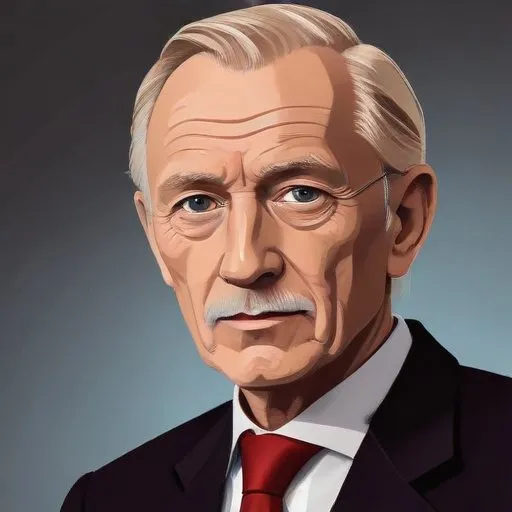
A Danish journalist and author who wrote about social issues and the lives of ordinary people, earning him the Nobel Prize in Literature in 1917.
Henrik Pontoppidan, a Danish realist writer, shared the Nobel Prize for Literature in 1917 with Karl Gjellerup, earning recognition for his authentic descriptions of present-day life in Denmark. His works, infused with a desire for social progress, presented an unusually comprehensive picture of his country and epoch.
Born on July 24, 1857, Pontoppidan was the son of a Jutlandic vicar and belonged to an old family of vicars and writers. He defied convention by giving up an education as an engineer, instead working as a primary school teacher and later becoming a freelance journalist and full-time writer. His literary debut in 1881 marked the beginning of a prolific career.
The first phase of Pontoppidan's work was characterized by rebellious social criticism, which also served as a revolt against his own privileged family background. In his famous quote, he mocked the historic Latinisation of his surname Pontoppidan from its original Danish root, Broby. His matter-of-fact short stories mercilessly described the life of peasants and country proletarians, with whom he lived in close contact.
Pontoppidan's early works, collected in Landsbybilleder (Village Pictures, 1883) and Fra Hytterne (From the Huts, 1887), were pioneering in their portrayal of farmers. He was perhaps the first Danish progressive writer to break with an idealized portrayal of farmers, offering a more realistic representation of their lives.
In 1890, Pontoppidan published Skyer (Clouds), a biting description of Denmark under the authoritarian semi-dictatorship of the Conservatives. The collection of short stories condemned the oppressors and scorned the Danes' lack of disaffection, solidifying his position as a vocal critic of the regime.
Pontoppidan's works have had a lasting impact on Danish literature and society. His commitment to social commentary and critique has inspired generations of writers and thinkers. As a leading figure of the Modern Breakthrough, he paved the way for a new era of literary and cultural expression in Denmark.
Pontoppidan's unique blend of social commentary and realistic portrayal of Danish life sets him apart from his contemporaries. His work can be seen as a bridge between the traditionalism of the previous era and the modernity of the 20th century, making him a crucial figure in the development of Danish literature.
Pontoppidan's writing was driven by a desire for social progress and a belief in the power of literature to effect change. His work reflects a deep commitment to realism, a rejection of idealized portrayals of society, and a willingness to confront the harsh realities of life.
Little is known about Pontoppidan's personal relationships, as he remained a private figure throughout his life. However, his writing often reflected his close connection to the people and landscapes of rural Denmark, which he drew inspiration from throughout his career.
Henrik Pontoppidan's remarkable life and works continue to inspire and influence writers, thinkers, and social critics to this day. His legacy serves as a testament to the power of literature to shape our understanding of the world and to drive social change.
Born in 1857
A Danish author and poet, known for his lyrical and philosophical works that explored the human condition, earning him the Nobel Prize in Literature in 1917.
Born in 1869
A Danish journalist and author who wrote influential works on social and political issues, particularly on the Danish resistance during World War II.
