


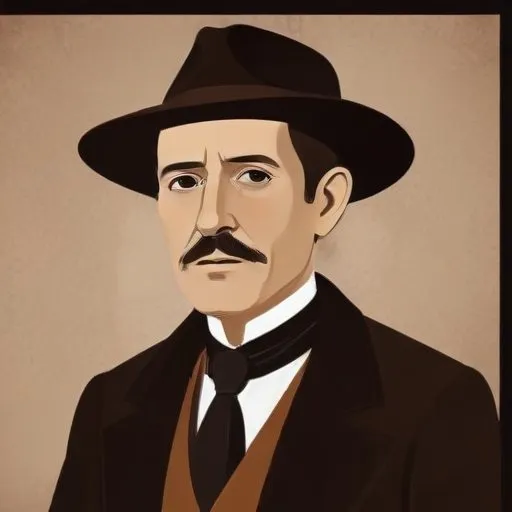
American archaeologist and author who excavated ancient Mayan ruins and wrote about his adventures, making archaeology accessible to the general public.
Mercer's eclectic interests and talents defied categorization, earning him a reputation as a true Renaissance man. His remarkable journey took him from the fields of archaeology and artifact collecting to the world of tilemaking and architecture, leaving an indelible mark on each discipline.
Born on June 24, 1856, in Doylestown, Pennsylvania, Mercer's curiosity and thirst for knowledge were evident from an early age. He attended Harvard University, where he earned a liberal arts degree between 1875 and 1879. Mercer then went on to study law at the University of Pennsylvania Law School, but it was during this period that he became a founding member of the Bucks County Historical Society, foreshadowing his future pursuits.
Mercer's travels to Europe in 1881 marked a significant turning point in his life. Over the next eight years, he immersed himself in the cultures and histories of France and Germany, developing a deep appreciation for the region's pottery and ceramics. This experience not only sharpened his archaeological skills but also instilled in him a sense of purpose, which would drive his future endeavors.
In the early 1890s, Mercer was appointed Curator of American and Prehistoric Archaeology at the University of Pennsylvania Museum. This position allowed him to combine his passion for archaeology and artifact collecting, leading to groundbreaking research and publications on ancient tool making and ceramics. His expertise in ceramics eventually led to the establishment of the Moravian Pottery and Tile Works in 1898, where he created stunning pieces that continue to inspire and delight art lovers today.
Mercer's innovative approach to architecture was evident in his poured concrete structures, which included his home, Fonthill, the Moravian Pottery and Tile Works, and the Mercer Museum. These buildings not only showcased his technical expertise but also reflected his commitment to preserving American history and culture.
Throughout his life, Mercer remained devoted to his craft, driven by an insatiable curiosity and a passion for learning. He wrote extensively on his interests, leaving behind a rich legacy of research, artistic creations, and architectural innovations. As we look back on his remarkable journey, we are reminded of the power of human creativity, the importance of preserving our cultural heritage, and the enduring impact of one man's unwavering dedication to his craft.
Born in 1621
A 17th-century naval commander and politician who played a significant role in the English Civil War and was a member of the Council of State during the Interregnum. He's also known for his victories against the Dutch Republic.
Born in 1706
A founding father of the United States, he was a leading figure in the Enlightenment, known for his groundbreaking inventions, scientific discoveries, and influential writings. He played a key role in shaping American history and politics.
Born in 1847
A pioneer in innovation, credited with developing groundbreaking inventions that revolutionized the way people live and communicate, including the light bulb and phonograph.
Born in 1863
Founded the pioneering automobile manufacturing company that revolutionized the industry with the assembly line production method, making cars more affordable and accessible to the masses.
Born in 1763
A German-American mogul who built a fur trading empire and invested in real estate, amassing a vast fortune, which he later used to support the arts and education.
Born in 1794
Built railroad empires, revolutionizing transportation and commerce, and donated extensively to education and the arts.
Born in 1835
A self-made industrialist who amassed a vast fortune in the steel industry, then donated most of it to fund over 2,500 public libraries and other philanthropic endeavors.
Born in 1839
Founded the Standard Oil Company, revolutionizing the oil industry and amassing vast wealth, which he later used for philanthropic efforts. He's remembered for his business acumen and generosity.
