


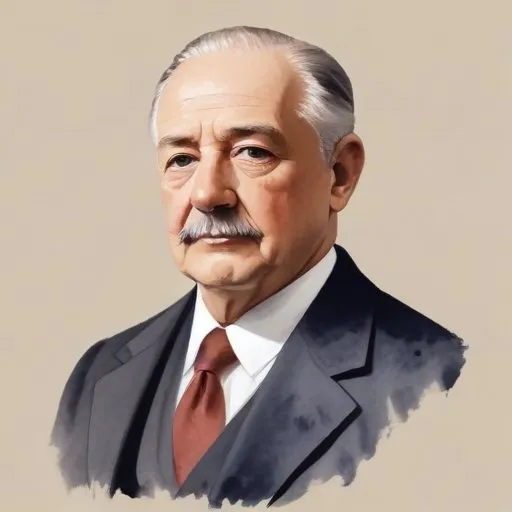
A prominent figure in Indiana University's history, serving as its president and guiding the institution through significant growth and development, while also writing extensively on banking and economics.
Herman B Wells, the eleventh president of Indiana University Bloomington, is renowned for his instrumental role in transforming the institution into a world-class center of higher learning. During his tenure, he oversaw massive expansions in enrollment, faculty recruitment, campus infrastructure development, and innovative program offerings, firmly establishing IU Bloomington as a hub of academic excellence.
Born on June 7, 1902, in Jamestown, Boone County, Indiana, Herman B Wells was the only child of Joseph Granville Wells and Anna Bernice Harting Wells. His father, a bank cashier, and his mother, a former teacher, instilled in him the value of education from an early age.
Wells began his career in banking but soon transitioned to academia, joining Indiana University Bloomington as an instructor and assistant professor in the Department of Economics (1930-1935). He later served as the Dean and Professor of Administration in the School of Business Administration (1935-1937) and Acting President (1937-1938).
In 1938, Wells became the President of Indiana University Bloomington, a position he held until 1962. During his presidency, he championed academic freedom, civil rights, and faculty-student relationships. He played a crucial role in expanding the university's programs, infrastructure, and faculty, which led to a significant increase in enrollment and the institution's overall growth.
After relinquishing his presidency in 1962, Wells took on the role of University Chancellor, a position he held until 2000. During this period, he continued to shape the university's development, focusing on campus beautification projects, faculty recruitment, and establishing new programs.
Wells was a staunch advocate for academic freedom, emphasizing the importance of intellectual independence and autonomy. He believed that education should be accessible to all, regardless of social or economic background. Throughout his career, he championed the cause of civil rights, particularly in the areas of racial and gender equality.
Wells' vision and leadership transformed Indiana University Bloomington into a premier institution of higher learning, producing esteemed alumni who have made significant contributions to various fields. His commitment to academic freedom, civil rights, and faculty-student relationships has inspired generations of educators and scholars.
Herman B Wells' legacy extends far beyond his tenure at Indiana University Bloomington. He has left an indelible mark on the world of higher education, inspiring generations of educators, administrators, and scholars. His commitment to academic excellence, diversity, and inclusivity continues to shape the institution's values and goals.
Wells passed away on March 18, 2000, leaving behind a rich legacy that continues to inspire and guide the academic community.
Born in 1839
Founded the Standard Oil Company, revolutionizing the oil industry and amassing vast wealth, which he later used for philanthropic efforts. He's remembered for his business acumen and generosity.
Born in 1837
Founded a powerful banking dynasty and dominated corporate finance, shaping the American economy through strategic investments and mergers.
Born in 1835
A self-made industrialist who amassed a vast fortune in the steel industry, then donated most of it to fund over 2,500 public libraries and other philanthropic endeavors.
Born in 1794
Built railroad empires, revolutionizing transportation and commerce, and donated extensively to education and the arts.
Born in 1763
A German-American mogul who built a fur trading empire and invested in real estate, amassing a vast fortune, which he later used to support the arts and education.
Born in 1649
A wealthy merchant who made his fortune in the East India Company and later donated generously to the Collegiate School of Connecticut, which was renamed Yale College in his honor.
Born in 1863
Founded the pioneering automobile manufacturing company that revolutionized the industry with the assembly line production method, making cars more affordable and accessible to the masses.
Born in 1855
A financier and diplomat who served as Secretary of the Treasury, known for shaping the country's economic policies and overseeing the Federal Reserve System. He also founded the National Gallery of Art.
