


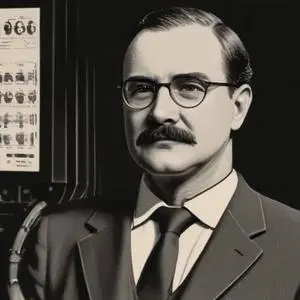
Co-founder of a company that pioneered data processing and invented the punched card system, revolutionizing data analysis and business operations.
Herman Hollerith, a pioneering American statistician, inventor, and businessman, revolutionized the way we process and analyze data with his groundbreaking electromechanical tabulating machine. This innovative invention, patented in 1884, marked the beginning of the era of mechanized binary code and semiautomatic data processing systems, dominating the landscape for nearly a century.
Herman Hollerith was born on February 29, 1860, in Buffalo, New York, to German immigrant parents. His father, Georg Hollerith, was a school teacher from Grofischlingen, Rhineland-Palatinate. Hollerith's early childhood was spent in Buffalo, where he developed a strong foundation in mathematics and science. He entered the City College of New York in 1875 and graduated from the Columbia School of Mines with an Engineer of Mines degree in 1879, at the tender age of 19.
In 1882, Hollerith joined the Massachusetts Institute of Technology, where he taught mechanical engineering and began conducting experiments with punched cards. It was during this period that he developed the tabulating system, which would later become the cornerstone of his life's work. The suggestion of John Shaw Billings, a renowned American physician and librarian, to create a mechanism using electrical connections to increment a counter, recording information, sparked Hollerith's ingenuity.
Hollerith's invention used a combination of punched cards, electromechanical counters, and a central processing unit to rapidly process and analyze large amounts of data. This pioneering technology enabled the rapid calculation of statistical data, paving the way for modern data processing and analysis. The impact of this invention was immense, and it quickly gained recognition, earning Hollerith a Ph.D. in 1890 from Columbia University.
In 1886, Hollerith founded the Tabulating Machine Company, which later amalgamated with several other companies to form the Computing-Tabulating-Recording Company (CTR) in 1911. In 1924, the company was renamed International Business Machines (IBM), one of the largest and most successful companies of the 20th century.
Herman Hollerith's contributions to the development of data processing are immeasurable. His invention of the punched card tabulating machine not only revolutionized data analysis but also paved the way for the development of computers. Today, IBM stands as a testament to Hollerith's vision and ingenuity, with his legacy continuing to inspire innovation in the field of data processing.
Hollerith lived in Washington, D.C., where he resided in Georgetown and maintained a business office near the Chesapeake and Ohio Canal. A commemorative plaque installed by IBM still stands as a tribute to his life and work. Hollerith passed away on November 17, 1929, at the age of 69, due to a heart attack.
Herman Hollerith's extraordinary life and work have left an indelible mark on the world of data processing. As a visionary and innovator, he dared to challenge the status quo, and his contributions continue to shape the landscape of modern technology. As we reflect on his remarkable journey, we are reminded of the transformative power of human ingenuity and the enduring legacy of a true pioneer.
Born in 1854
The inventor's trusted right-hand man, who helped bring the telephone to life and famously received the first phone call, "Mr. Watson, come here, I want to see you."
Born in 1791
A pioneer in computer science, credited with inventing the first mechanical computer, the Difference Engine, and conceptualizing the Analytical Engine, a precursor to modern computers.
Born in 1815
Pioneering mathematician and computer scientist who wrote the first algorithm intended to be processed by a machine, and is often considered the first computer programmer. Her work on Charles Babbage's Analytical Engine envisioned its potential to go beyond mere calculation and perform any task that could be expressed in a series of steps.
Born in 1749
Developed nebular hypothesis of the origin of the solar system and formulated Laplace's equation, a fundamental concept in mathematics and physics. He's considered the founder of celestial mechanics.
Born in 1856
Developed the theory of Markov chains, a mathematical system that undergoes transitions from one state to another, and is widely used in computer science, biology, and economics.
Born in 1915
Developed statistical methods and data visualization techniques that transformed the field of data analysis, making complex data more accessible and understandable.
Born in 1820
Pioneering nurse and statistician who revolutionized healthcare by introducing sanitation practices and data-driven decision making, becoming the founder of modern nursing.
