


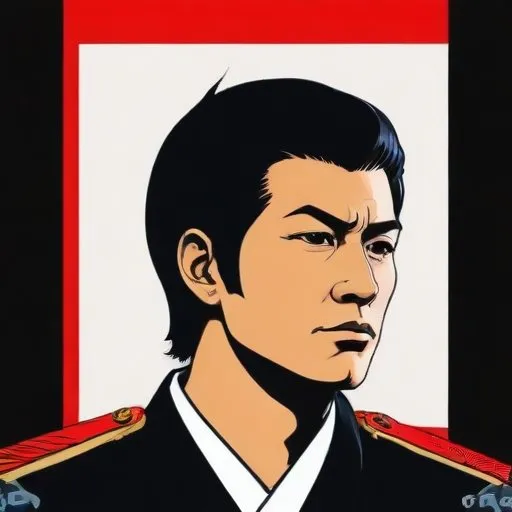
Leader of the Shinsengumi, a group of samurai who fought to preserve the Tokugawa shogunate during Japan's Meiji Restoration, known for his bravery and unwavering dedication to his cause.
Hijikata Toshiz, a Japanese warrior, is renowned for his unwavering dedication to the Shinsengumi, a elite corps of samurai, and his unrelenting resistance against the Meiji Restoration. As the Vice-Commander, Fukucho, of the Shinsengumi, he fought to his last breath, leaving an indelible mark on Japanese history.
Born on May 31, 1835, in the Ishida village, Tama region of Musashi Province (present-day Ishida, Hino, Tokyo, Japan), Hijikata was the youngest of ten children. His father, Hijikata Yoshiatsu Hayato, a well-to-do farmer, passed away a few months before his birth. His eldest brother, Tamejiro, was born blind and could not inherit the family property, while his third older brother, Daisaku (later Kasuya Ryojin), was adopted to another family and would later become a physician.
Hijikata spent his youth selling his family's Ishida sanyaku medicine, which treated injuries such as bruises and broken bones, while practicing his self-taught kenjutsu. His brother-in-law, Sat Hikogor, who was married to his older sister Nobu, managed a Tennen Rishinry dojo in Hino, where Hijikata later met Kond Isami and was formally enrolled at the Tennen Rishinry's Shieikan in 1859. Although Hijikata himself never fully mastered the Tennen Rishinry, it is said that he managed to develop the Shinsengumi-Kenjutsu fighting style from the Tennen Rishinry.
In 1863, Hijikata joined the Shinsengumi, an elite corps of samurai, along with Kond Isami and others. As the Vice-Commander, Fukucho, of the Shinsengumi, Hijikata played a crucial role in resisting the Meiji Restoration, which sought to modernize Japan and abolish the samurai class. He fought in several battles, including the Battle of Toba-Fushimi, where the Shinsengumi suffered a crushing defeat.
Hijikata Toshiz died on June 20, 1869, during the Battle of Hakodate, the final battle of the Boshin War. Despite his untimely death, Hijikata's legacy lived on, and he became a legendary figure in Japanese history. He is remembered for his unwavering loyalty, bravery, and dedication to the Shinsengumi and the samurai code.
Hijikata's philosophy was deeply rooted in the samurai code, which emphasized loyalty, honor, and self-discipline. He believed in the importance of upholding traditional values and resisting Western influence, which he saw as a threat to Japanese culture.
Hijikata's role in the Shinsengumi and his resistance against the Meiji Restoration have been the subject of much controversy and debate. Some have portrayed him as a heroic figure, while others have seen him as a reactionary trying to cling to the old ways.
"Even if it means certain death, I will never surrender." - Hijikata Toshiz
Through his life and legacy, Hijikata Toshiz continues to inspire generations of Japanese people and beyond, serving as a testament to the enduring spirit of the samurai.
