


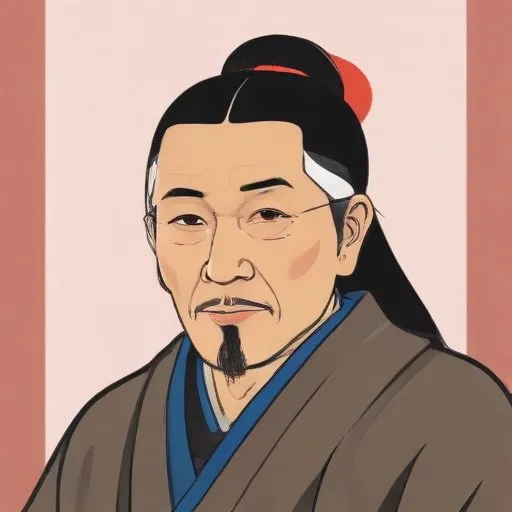
A prominent Japanese neo-Confucian scholar, teacher, and writer who contributed significantly to the development of Confucianism in Japan, particularly in the 17th century. His works focused on ethics, morality, and governance.
Hirose Tanso, a renowned neo-Confucian scholar, teacher, and writer, left an indelible mark on Japan's intellectual landscape during the late Edo period. His extensive contributions to education, literature, and philosophy continue to inspire generations, solidifying his position as one of Japan's most influential thinkers.
Born on May 22, 1782, in Uomachi, Mamedacho, Hitagun, Bungo Province, Hirose Tanso was the eldest son of Hakataya Saburoemon, a wealthy merchant. His given name was Toranosuke. A child prodigy, he began learning to read and practicing Japanese calligraphy at the tender age of six, and started studying Chinese classics at nine.
At ten, Hirose became a student of Chikuin Matsushita, a ronin from Kurume who frequented the Hita magistrate's office. He excelled in Chinese poetry and lectured the magistrate of Hita on filial piety at just 13 years old. His academic prowess continued to flourish, and at 16, he attended Kamei Juku in Chikuzen Province, where he studied under the father-and-son duo Kamei Nanmei and Shoyo.
In 1801, Hirose founded the Academy NeoConfucian Kangien, a private Confucian academy that would go on to become one of the largest in Japan. The academy continued to operate after his death, with his younger brothers Hirose Kyosho, Hayashigai, and Hirose Seison at the helm, until 1897. At its peak, the academy boasted over 4,000 students in 1871, producing Confucian and Buddhist monks, doctors, politicians, administrators, traders, farmers, and samurai.
Hirose published an anthology of his poems in 1837. Later, a three-volume edition of his writings was published as TANSO Zenshu. These works showcase his mastery of Chinese poetry and prose, solidifying his reputation as a literary giant.
Hirose's philosophical ideas were deeply rooted in neo-Confucianism, emphasizing the importance of moral values, self-cultivation, and social responsibility. He believed in the power of education to transform individuals and society, advocating for the development of a virtuous and just society.
Hirose Tanso's contributions to education, literature, and philosophy have had a profound and lasting impact on Japanese society. His Academy NeoConfucian Kangien played a pivotal role in shaping the country's intellectual landscape, producing many prominent figures who went on to shape Japan's modernization. Today, he is remembered as a pioneering figure in Japanese education, a testament to the power of knowledge and wisdom.
Hirose Tanso's remarkable life and achievements serve as a beacon of inspiration, reminding us of the transformative power of education, literature, and philosophy. His legacy continues to influence Japanese society, a lasting tribute to his unwavering commitment to knowledge and wisdom.
Born in 1730
A prominent figure in Japanese literature, known for reviving and interpreting ancient Japanese texts, and creating a new wave of poetic and literary movements.
