


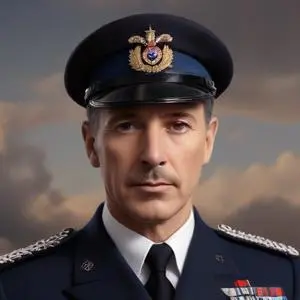
Leader of RAF Fighter Command during the Battle of Britain, credited with developing the air defense system that repelled the German Luftwaffe's attack on Britain.
Hugh Dowding, 1st Baron Dowding, is renowned for his instrumental role in shaping Britain's air defense system, which played a pivotal part in the Allied victory during World War II. As the commander-in-chief of RAF Fighter Command, Dowding masterminded the country's air defenses, thwarting the German Luftwaffe's relentless bombing campaign and securing a vital advantage for the British during the Battle of Britain.
Hugh Caswall Tremenheere Dowding was born on April 24, 1882, in Moffat, Scotland. After graduating from the Royal Military College at Sandhurst, Dowding began his military career in 1900, serving in the British Army and later transferring to the Royal Flying Corps in 1914. During World War I, he saw action in France and was wounded in 1915. After the war, he remained in the RAF, rising through the ranks and becoming a proponent of air power and its importance in modern warfare.
In the 1930s, Dowding championed the development and implementation of radar technology, recognizing its potential to revolutionize air defense. He worked closely with scientists and engineers to perfect the system, which ultimately enabled the British to detect and respond to incoming German aircraft more effectively. Dowding's foresight and perseverance in promoting radar technology proved crucial in the Battle of Britain, as it allowed British fighter pilots to intercept enemy bombers with greater accuracy and precision.
In July 1940, Dowding's carefully crafted air defense strategy was put to the test as the German Luftwaffe launched a series of intense bombing raids on Britain. Through a combination of radar, ground control systems, and skilled fighter pilots, the RAF, under Dowding's leadership, successfully repelled the German attacks, inflicting heavy losses on the enemy. The Battle of Britain, which lasted until October 1940, marked a turning point in the war, as the British secured a vital victory that prevented a potential German invasion.
After the war, Dowding was knighted in 1942 and elevated to the peerage as 1st Baron Dowding in 1943. He continued to serve in various capacities, including as a member of the Air Council and as a vocal advocate for the importance of air power in modern warfare. Dowding passed away on February 15, 1970, at the age of 87, leaving behind a legacy as one of the most influential and innovative military leaders of the 20th century.
"The bomber will always get through." - Hugh Dowding, on the importance of air defense
Dowding's remarkable achievements during World War II have been recognized as a turning point in the conflict, and his pioneering work in air defense has had a lasting impact on modern military strategy. Today, he is remembered as a visionary leader who played a crucial role in shaping the course of history.
Born in 1871
Prolific writer of historical novels and adventure stories, also a talented landscape painter.
Born in 1869
The Prime Minister who infamously appeased Nazi Germany with the Munich Agreement, hoping to avoid war, but ultimately contributing to its outbreak. He's a symbol of failed diplomacy and naivety in the face of aggression.
Born in 1893
A high-ranking Nazi official, he was a decorated World War I fighter pilot and later became a prominent politician, serving as Minister President of Prussia. He's infamous for his role in the Nazi regime and war crimes trials.
