


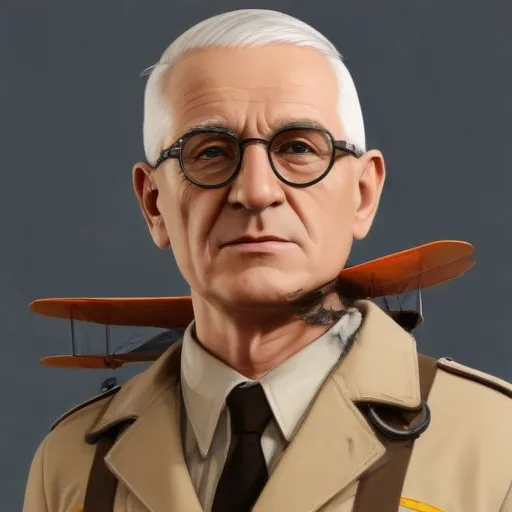
A pioneering aeronautical engineer who designed the first all-metal aircraft, revolutionizing aviation with his innovative designs. His creations paved the way for modern air travel.
Hugo Junkers, a German aircraft engineer and designer, revolutionized the aviation industry with his innovative designs of all-metal airplanes and flying wings. His company, Junkers Flugzeug und Motorenwerke AG (Junkers Aircraft and Motor Works), became one of the mainstays of the German aircraft industry between World War I and World War II.
Born on February 3, 1859, in Rheydt, Prussian Rhine Province, Junkers was the son of a wealthy industrialist. After completing his Abitur exams in 1878, he attended the Royal Polytechnic University in Charlottenburg and the Royal Technical University in Aachen, where he completed his engineering studies in 1883.
Junkers' most notable contribution to aviation was the design of all-metal aircraft, which replaced traditional wood and fabric construction. His innovative designs included the Junkers J 1 (1915), the world's first practical all-metal aircraft, featuring a cantilever wing design with minimal external bracing. He also developed the Junkers F 13 (1919), the world's first all-metal passenger aircraft.
In addition to aircraft, Junkers held various thermodynamic and metallurgical patents and built both diesel and petrol engines. His designs had a profound impact on the aviation industry, enabling the development of safer, more efficient, and reliable aircraft.
Junkers' legacy is evident in his numerous achievements, including the development of the Junkers W 33, which made the first successful heavier-than-air east-to-west crossing of the Atlantic Ocean. His iconic Junkers Ju 52, affectionately nicknamed "Tante Ju," was one of the most famous airliners of the 1930s.
Despite his pioneering work, Junkers' life took a dramatic turn when the Nazis came into power in 1933. They requested his aid in German rearmament, but Junkers declined, leading to his house arrest in 1934 and eventual seizure of his patents and company. Under Nazi control, his company produced some of the most successful German warplanes of World War II. Junkers passed away in 1935.
Junkers was not only an innovator in aviation but also a patron of the arts. He was one of the main sponsors of the Bauhaus movement, a groundbreaking art and design school that revolutionized modern aesthetics. In 1925, he facilitated the move of the Bauhaus from Weimar to Dessau, where his factory was situated.
Hugo Junkers' pioneering work in aviation, his innovative designs, and his patronage of the arts have left an indelible mark on history. His legacy continues to inspire generations of engineers, designers, and artists, cementing his place as one of the most influential figures in aviation history.
Born in 1890
Founded the Fokker Aircraft Manufacturer, revolutionizing aviation with innovative designs and production methods. Known for creating iconic planes that dominated the skies during World War I and the 1920s.
Born in 1834
Co-founder of the first high-speed internal combustion engine and the company that bears his name, revolutionizing the automotive industry with innovative designs and manufacturing techniques.
Born in 1846
Founded the luxury car brand Maybach, known for designing and building high-performance engines and exclusive vehicles. His innovative designs and precision engineering set a new standard for the automotive industry.
Born in 1838
A German general and entrepreneur who pioneered the development of rigid airships, revolutionizing aviation and transportation in the late 19th and early 20th centuries. He founded a company that bore his name and built iconic airships that dominated the skies.
Born in 1888
Founded the company that produced the first jet-powered aircraft and designed planes used by the German military during World War II. His innovative designs revolutionized aviation technology.
Born in 1898
Designed and manufactured iconic German aircraft, including the Me 109 fighter plane, which played a significant role in World War II. His company also produced cars and motorcycles after the war.
Born in 1881
A pioneer in aerodynamics and fluid dynamics, known for his groundbreaking work on vortex streets and supersonic flight, as well as being a founder of NASA's Jet Propulsion Laboratory.
