


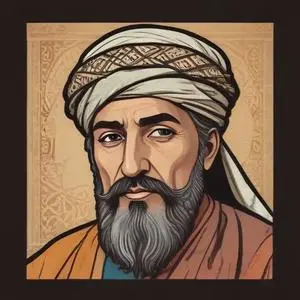
A 13th-century Andalusian Sufi mystic, poet, and philosopher who wrote extensively on spirituality, mysticism, and the nature of reality, influencing Islamic thought and Western philosophy. Their works are still studied and revered today.
Ibn Arabi, a 12th-century Andalusi Arab scholar, mystic, poet, and philosopher, is renowned for his profound contributions to Islamic thought, particularly his concept of Wahdat ul-Wujud, or the Unity of Being. This visionary teacher is celebrated for his cosmological teachings, which have had a lasting impact on the Muslim world, earning him the esteemed title of Shaykh al-Akbar, or "The Greatest Teacher."
Born in Murcia, Al-Andalus (modern-day Spain) in 1165 AD, Ibn Arabi was born into a noble Arab family. His full name, Ab Abd Allah Muhammad ibn Al-Arabi al-Tai al-Hatimi, reflects his illustrious lineage. He was later referred to as the father of Abd Allah, following the classical Arabic tradition.
Ibn Arabi's philosophical contributions are immense, with over 850 works attributed to him, of which 700 are considered authentic. His magnum opus, Fusus al-Hikam (The Bezels of Wisdom), is a comprehensive treatise on Sufism, Cosmology, and the nature of God. He is celebrated for his concept of Wahdat ul-Wujud, which posits that all existence is a manifestation of a singular, absolute reality.
This monist doctrine, which he equated with the Absolute Being (al-wujud al-mutlaq), has had a profound impact on Sufi thought and Islamic philosophy. Ibn Arabi's teachings emphasize the unity of existence, the interconnectedness of all things, and the ultimate reality of the divine.
Ibn Arabi's thought has permeated various aspects of modern society, from literature to art, and even influenced Western philosophers such as Voltaire and Kant. His concept of Wahdat ul-Wujud has inspired numerous Sufi orders and mystical traditions, shaping the spiritual trajectory of millions.
Ibn Arabi's most famous works include:
His legacy extends beyond the Islamic world, with his teachings influencing Western philosophers, mystics, and writers. He is revered as a saint by many Muslim communities and Sufi orders, and his thought continues to inspire spiritual seekers globally.
"The truth has a certain elegance, simplicity, and clarity that is beyond argument."
"The universe is a single, undivided whole, and its various parts are but diverse manifestations of the same reality."
Ibn Arabi's life and teachings unfolded during a period of great cultural and intellectual ferment in the Islamic world. His thought was shaped by the rich cultural heritage of Al-Andalus, the interactions between Islamic, Christian, and Jewish scholars, and the mystical traditions of Sufism.
His legacy continues to inspire and guide spiritual seekers, philosophers, and scholars across the globe, cementing his place as one of the most influential thinkers in Islamic history.
Born in 1207
A 13th-century Persian poet and Sufi mystic who wrote spiritual and romantic poetry that explores the nature of love, spirituality, and the human condition. His works have transcended time and cultures, inspiring countless readers and seekers.
Born in 1126
A renowned medieval philosopher and physician who wrote influential commentaries on Aristotle's works, shaping Western philosophy and Islamic thought.
