


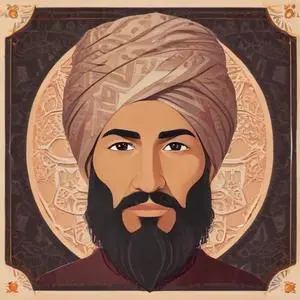
A medieval traveler and scholar who explored much of the Islamic world, documenting his journeys and cultural observations in a famous travelogue.
Ibn Battuta, a 14th-century Islamic scholar, is renowned for his incredible journeys that spanned over three decades, covering an astonishing 73,000 miles (117,000 km) across Africa, Asia, and Europe. He is widely regarded as the greatest traveler of all time, outdistancing his contemporaries, including Marco Polo and Zheng He.
Ibn Battuta was born on February 24, 1304, in Tangier, Morocco, during the reign of the Marinid dynasty. He belonged to a family of Islamic legal scholars, known as qadis, and was of Berber descent. His full name, Shams al-Din Abu Abdullah Muhammad ibn Abdullah ibn Muhammad ibn Ibrahim ibn Muhammad ibn Yusuf Lawati al-Tanji ibn Battuta, reveals his rich cultural heritage.
As a young man, Ibn Battuta studied at a Sunni Maliki madhhab Islamic jurisprudence school, which was the dominant form of education in North Africa at that time. This education laid the foundation for his future career as a religious judge and scholar.
In 1325, Ibn Battuta embarked on his first journey, traveling from Tangier to Mecca, a pilgrimage that marked the beginning of his extraordinary travels. Over the next three decades, he visited most of North Africa, the Middle East, East Africa, Central Asia, South Asia, Southeast Asia, China, the Iberian Peninsula, and West Africa.
Ibn Battuta's travelogue, commonly known as The Rihla, is a remarkable account of his journeys. Written in Arabic, it is a treasure trove of information on the cultures, customs, and traditions of the regions he visited. The book is a testament to his intellectual curiosity and passion for exploration.
Ibn Battuta's travels were not just about exploring new lands; they were also a spiritual journey. He was deeply rooted in Islamic traditions and saw his travels as a way to spread Islamic knowledge and values. Throughout his journeys, he interacted with scholars, sufis, and rulers, engaging in intellectual debates and discussions that enriched his understanding of the world.
Ibn Battuta's legacy extends far beyond his travels. His writings have inspired generations of scholars, explorers, and travelers. His detailed accounts of the regions he visited have contributed significantly to our understanding of the history and cultures of those areas.
Ibn Battuta's remarkable journeys have left an indelible mark on the history of exploration and travel. His written accounts have inspired countless travelers, scholars, and explorers, and continue to fascinate readers to this day.
As we reflect on Ibn Battuta's extraordinary life, we are reminded of the power of curiosity, intellectual pursuit, and the human spirit of adventure. His legacy is a testament to the boundless potential of human exploration and discovery.
Born in 1254
Traveled extensively throughout Asia, documenting his journeys and discovering new trade routes, which greatly influenced European exploration and commerce.
Born in 1911
A veteran character actor with a distinctive voice, he appeared in numerous films and TV shows, often playing authority figures or villains.
Born in 1332
A 14th-century polymath who wrote extensively on history, sociology, and economics, leaving behind a rich legacy of insightful works that continue to influence modern thought.
