


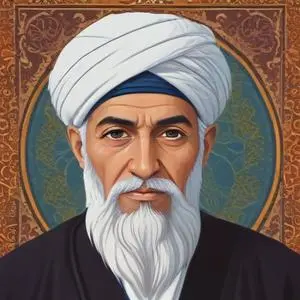
A 13th-century Syrian scholar and theologian who wrote extensively on Islamic law, theology, and philosophy, and is known for his critiques of Sufism and Greek philosophy.
Ibn Taymiyyah, a 14th-century Islamic scholar, theologian, and philosopher, is renowned for his unyielding commitment to reviving Islamic orthodoxy and his fierce critiques of philosophical and mystical traditions of his time. Through his voluminous writings and teachings, he challenged the prevailing intellectual currents, leaving an indelible mark on Islamic thought and jurisprudence.
Born in 1263 CE in Harran, southern Turkey, Ibn Taymiyyah grew up in a family of scholars and theologians. His early education in Islamic studies, jurisprudence, and theology laid the foundation for his future intellectual pursuits.
As a young scholar, Ibn Taymiyyah was drawn to the works of Imam Ahmad ibn Hanbal, a prominent Islamic theologian and jurist. He became fascinated with the Hanbali school of thought, which emphasized the importance of adhering to the Quran, the Hadith (Prophetic traditions), and the consensus of the Muslim community.
Ibn Taymiyyah's magnum opus, Aqidah al-Wasitiyah, is a comprehensive treatise on Islamic theology and creed. In this work, he presents a systematic and nuanced exposition of Islamic beliefs, refuting the philosophical and theological deviations of his time.
He argued that the Quran and the Sunnah (Prophetic traditions) were the sole sources of Islamic knowledge and that human reason and intellect should be subservient to revelation. Ibn Taymiyyah's emphasis on the importance of scriptural authority and the role of reason in understanding revelation resonated with many Muslims seeking a return to the original teachings of Islam.
Ibn Taymiyyah's ideas have had a profound impact on modern Islamic thought and activism. His emphasis on the importance of adhering to Islamic traditions and the rejection of innovations (bid'ah) has inspired generations of Islamic reformers and revivalists.
His critiques of Sufism, in particular, have influenced the development of modern Islamist movements, which often view Sufism as a deviation from the true teachings of Islam. However, this has also led to controversies and criticism from Sufi scholars and adherents, who see Ibn Taymiyyah's views as overly rigid and dismissive of the spiritual dimensions of Islam.
Ibn Taymiyyah's unyielding stance on various issues has led to controversy and debate throughout history. His critiques of certain Sufi practices, such as the veneration of saints and the celebration of mystical anniversaries, have been seen as divisive and intolerant by some.
His involvement in political debates and power struggles has also led to accusations of extremism and militancy. Nevertheless, Ibn Taymiyyah's commitment to upholding Islamic orthodoxy and his rejection of what he saw as innovations and deviations has earned him a revered status among many Muslims.
"The righteous predecessors were not glorified except through their righteousness, and the innovators were not destroyed except through their innovations." - Ibn Taymiyyah
"The Quran is the word of Allah, and it is the source of all knowledge and wisdom. It is the criteria for judging all matters, and it is the foundation of all sciences." - Ibn Taymiyyah
Ibn Taymiyyah lived during a time of great intellectual and cultural ferment in the Islamic world. The Mongol invasions, the rise of Sufism, and the proliferation of philosophical and mystical schools of thought created a complex and contested intellectual landscape.
Through his writings and teachings, Ibn Taymiyyah sought to provide a coherent and authoritative vision of Islamic orthodoxy, one that would unite Muslims and guide them towards a more faithful and authentic practice of their faith. His legacy continues to shape Islamic thought and discourse, inspiring both admiration and critique from scholars and laypeople alike.
Ibn Taymiyyah was known for his close relationships with other prominent scholars and theologians of his time, including Ibn Qayyim al-Jawziyyah, who was his most famous student.
According to legend, Ibn Taymiyyah was once imprisoned by the Mongols, who sought to persecute him for his vocal opposition to their rule. During his imprisonment, he continued to write and teach, using his confinement as an opportunity to deepen his spiritual practice and intellectual pursuits.
Born in 1372
A renowned Islamic scholar and jurist who wrote extensively on Islamic law, theology, and history, particularly his commentary on the Hadith, a collection of the Prophet Muhammad's sayings and actions.
