


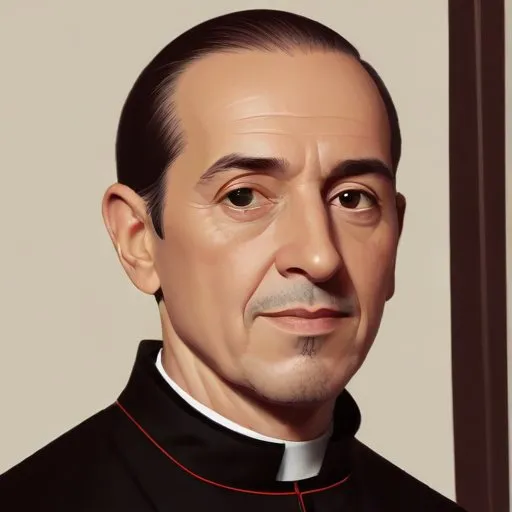
A Spanish prelate who served as the president of the Pontifical Academy for Life, promoting Catholic teachings on bioethics and human life. He played a key role in shaping the Catholic Church's stance on life issues.
Ignacio Carrasco de Paula, a Spanish prelate of the Catholic Church, is renowned for his unwavering commitment to upholding the sanctity of human life and promoting moral values. As the former president of the Pontifical Academy for Life, he has been a steadfast advocate for the protection of human dignity and the defense of the unborn.
Born on October 25, 1937, in Barcelona, Spain, Carrasco de Paula was ordained as a priest for the Personal Prelature of Opus Dei on August 8, 1966. He went on to serve as a professor of moral theology at the Pontifical University of the Holy Cross from 1984 and later became the rector of the university from 1984 to 1994.
Carrasco de Paula's expertise in bioethics led him to become the director of the Bioethics Institute of the Universit Cattolica del Sacro Cuore in Rome. He has also been a member of the ethics committee of the experimentation clinic at the Gemelli Policlinic in Rome. His work in bioethics has been instrumental in shaping the Catholic Church's stance on complex moral issues.
In 1994, Pope John Paul II appointed Carrasco de Paula as a consultor for the Academy for Life. He served as its chancellor from 2005 to 2010, before being appointed as the president of the Pontifical Academy for Life by Pope Benedict XVI in 2010.
In his capacity as president of the Pontifical Academy for Life, Carrasco de Paula has been an outspoken critic of abortion and in vitro fertilization. He has condemned Spain's legislation legalizing abortion and has spoken out against the Nobel Prize for Medicine awarded to Robert Edwards for his work on in vitro fertilization, citing the devastating consequences for human embryos.
On September 15, 2010, Pope Benedict XVI named Carrasco de Paula Titular Bishop of Thapsus. He received his episcopal ordination from Cardinal Tarcisio Bertone on October 9, 2010. Throughout his episcopate, Carrasco de Paula has remained a steadfast champion of life and morality, inspiring countless individuals to stand up for the dignity of human life.
Ignacio Carrasco de Paula's unwavering commitment to upholding the sanctity of human life has had a profound impact on modern society. His work has inspired a new generation of advocates for life and has shaped the Catholic Church's stance on complex moral issues.
Ignacio Carrasco de Paula's philosophical contributions and beliefs are deeply rooted in Catholic doctrine and the defense of human life. His work has been shaped by his commitment to promoting moral values and upholding the dignity of human life.
Born in 1920
Leader of the Catholic Church from 1978 to 2005, known for helping to end communism in Poland and being a charismatic advocate for human rights and social justice.
99 Years Old
The first pope to resign in nearly 600 years, he's known for his conservative views and efforts to strengthen the Catholic Church's traditional teachings. He's also a prolific writer and theologian.
89 Years Old
The leader of the Catholic Church, known for his progressive stance on social issues and efforts to reform the Church, inspiring millions worldwide.
81 Years Old
A prominent Catholic leader and theologian, known for his influential writings on Catholic doctrine and his role in shaping the Church's stance on various issues.
98 Years Old
A prominent Catholic Church leader who served as Secretary of State and Dean of the College of Cardinals, known for his diplomatic efforts and influential role in the Church's governance.
91 Years Old
A high-ranking Catholic Church official who served as the Vatican's Secretary of State and Camerlengo, playing a key role in the papal transition following Pope John Paul II's death. He was also known for his conservative views and controversies surrounding his leadership style.
89 Years Old
A prominent Catholic Church leader who served as the President of the Pontifical Council for the Family and played a key role in shaping the Church's stance on family and life issues.
