


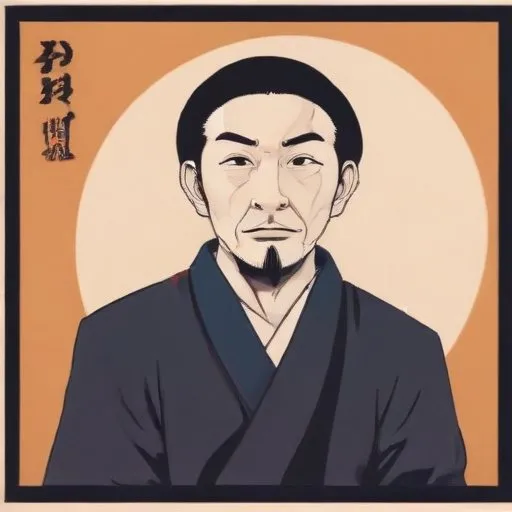
A Japanese philosopher and author who wrote about the importance of individualism and the need to break free from societal norms, influencing Japan's modernization.
Ikki Kita, a Japanese author, intellectual, and political philosopher, is renowned for his eclectic and often contradictory ideologies that spanned socialism, pan-Asianism, Nichiren Buddhism, and egalitarianism. His writings, although censored and eventually ceasing in 1923, continued to inspire far-right elements in Japanese politics until the 1930s, earning him the dubious distinction as the ideological father of Japanese fascism.
Born on Sado Island, Niigata Prefecture, in 1883, Kita's upbringing was marked by a rebellious spirit, which he attributed to his island's history of penal transportation. His father, a sake merchant and the first mayor of the local town, instilled in him a deep appreciation for Chinese classics, which he studied in his youth. At the age of 14, Kita became fascinated with socialism, a passion that would shape his future writings and philosophies.
In 1900, Kita began publishing articles in a local newspaper, criticizing the Kokutai Structure of State theory. This bold move led to a police investigation, which was eventually dropped. Undeterred, he continued to hone his craft, moving to Tokyo in 1904 to audit lectures at Waseda University. Although he never earned a university degree, Kita's interactions with influential figures in the early socialist movement in Japan left him disillusioned, believing the movement was tainted by opportunism.
In 1906, at the age of 23, Kita published his magnum opus, a 1,000-page political treatise titled The Theory of Japan's National Polity and Pure Socialism. This comprehensive work showcased his eclectic range of influences, touching upon socialism, pan-Asianism, Nichiren Buddhism, and egalitarianism. Although censored, the book cemented Kita's reputation as a bold and provocative thinker.
Kita's philosophical beliefs defied easy categorization. He was a self-described socialist who advocated for territorial expansion and a military coup, yet his writings also emphasized fundamental human rights and egalitarianism. This paradoxical blend of ideologies continues to fascinate and perplex scholars, earning him a reputation as a complex and enigmatic figure.
Kita's ideas, although disruptive and dangerous in the eyes of the government, inspired elements on the far-right of Japanese politics into the 1930s. His advocacy for territorial expansion and a military coup continues to be a subject of controversy, with some viewing him as a precursor to the country's militaristic era. Kita's legacy serves as a cautionary tale about the dangers of unchecked nationalism and the importance of responsible political ideologies.
Kita's life was marked by turmoil and controversy, ultimately meeting a tragic end. His ideas, however, continue to resonate, inviting us to reflect on the complexities of Japanese history and the importance of responsible political ideologies.
Ikki Kita's legacy is a testament to the power of ideas, both inspiring and disturbing. As we grapple with the complexities of his philosophical beliefs, we are reminded of the importance of critical thinking, responsible political ideologies, and the dangers of unchecked nationalism. Kita's story serves as a warning, urging us to navigate the complexities of human history with nuance and compassion.
