


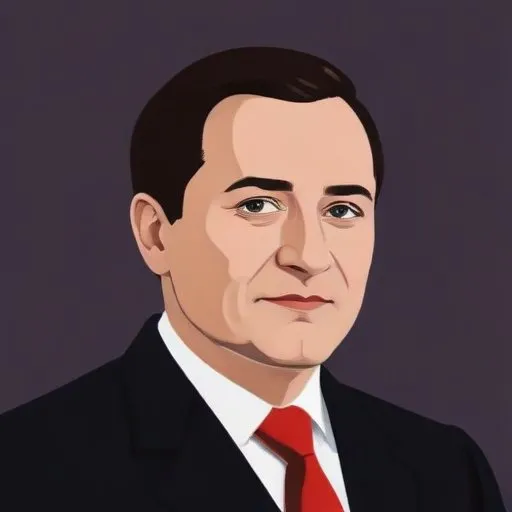
A Bessarabian academic and politician who served as President of Moldova, known for his efforts to strengthen Moldovan independence and sovereignty. He played a key role in shaping the country's post-Soviet era.
Ion Incule, a prominent Bessarabian and Romanian politician, is best known for his pivotal role as the President of the Country Council of the Moldavian Democratic Republic and Minister of the Interior of Romania. His remarkable journey, which spanned over three decades, left an indelible mark on the region's politics, education, and scientific community.
Born on April 5, 1884, in Rzeni village, Ion Incule grew up in a family of modest means. His parents, Constantin and Maria Incule, encouraged his academic pursuits, which led him to graduate from the primary school in his native village.
In 1894, Incule was admitted to the Theological School in Chiinu, where he excelled and eventually graduated with very good grades. This achievement earned him a spot at the Theological Seminary, where he studied alongside future deputies and state dignitaries Vasile Brc and Pantelimon Erhan.
In 1904, Incule's passion for exact sciences led him to enroll at the faculty of physics and mathematics of Dorpat University in Estonia. After a year, he transferred to the prestigious Saint Petersburg Imperial University, where he graduated with a 1st degree diploma in physics and mathematics.
Incule's academic excellence earned him a recommendation for postgraduate studies. However, he chose to pursue a career in education, working as a private lecturer at several private schools in Petersburg. He taught physics, mathematics, and astronomy, inspiring a new generation of students.
In 1915, Incule earned his PhD, which opened doors to new opportunities. He became a physicist at the Meteorological Observatory in Petersburg, while simultaneously writing for the Basarabia newspaper, edited by Constantin Stere.
In April 1917, Incule returned to Bessarabia as an emissary of the President of the Provisional Government, Alexander Kerensky. This marked the beginning of his political career, as he became an MP in the Petrograd Soviet from the Socialist Revolutionary Party.
Incule's leadership and vision led to his appointment as the President of the Country Council of the Moldavian Democratic Republic. During his tenure, he worked tirelessly to promote the region's autonomy and cultural identity.
In 1918, Incule became a full member of the Romanian Academy, a testament to his contributions to science, politics, and education. He continued to serve as Minister of the Interior of Romania, leaving a lasting impact on the country's development.
Incule's work was deeply rooted in his commitment to democracy, social justice, and cultural preservation. He believed in the power of education and scientific inquiry to drive progress and improve people's lives.
Throughout his career, Incule remained true to his convictions, often taking an unconventional approach to address the challenges facing his community. His unwavering dedication to the region's development earned him the respect and admiration of his peers and contemporaries.
Ion Incule's remarkable life and achievements serve as a testament to his unwavering commitment to the betterment of his community. His legacy continues to inspire future generations, reminding us of the importance of education, cultural preservation, and visionary leadership.
Born in 1858
A Romanian politician, diplomat, journalist, and lawyer who played a key role in the country's early 20th-century politics and was a strong advocate for national unity and democracy.
Born in 1882
A renowned Romanian diplomat and academic who served as Minister of Foreign Affairs, known for his influential role in shaping international relations and advocating for collective security in the interwar period.
