


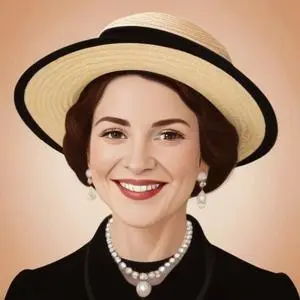
Developed the Myers-Briggs Type Indicator (MBTI), a widely used personality assessment tool that helps individuals understand their strengths and preferences. Her work has had a significant impact on fields such as psychology, education, and business.
Isabel Briggs Myers is renowned for co-creating the Myers-Briggs Type Indicator (MBTI), one of the most widely used personality tests globally, with her mother, Katharine Cook Briggs. Over two million people complete the questionnaire annually, making it an indispensable tool for understanding human behavior and personality traits.
Isabel Briggs Myers was born on October 18, 1897, in Washington, D.C. She was homeschooled by her mother, Katharine Cook Briggs, who instilled in her a love for learning and a strong foundation in language and literature. Her father, Lyman J. Briggs, was a research physicist who worked at the National Bureau of Standards. Myers later attended Swarthmore College, where she studied political science and met her future husband, Clarence "Chief" Gates Myers, a law student.
Myers' writing talent was evident from an early age. In 1928, she participated in a mystery novel writing contest jointly offered by McClure's magazine and Frederick A. Stokes Company. Her novel, Murder Yet to Come, won the contest and was published periodically in The Smart Set magazine between August 1929 and January 1930. The novel was later published in book form by Frederick A. Stokes Company on January 2, 1930. The contest prize included a $7,500 cash award (equivalent to $133,000 in 2023) and a contract for a second work of fiction.
During World War II, Myers read an article titled "Fitting the Worker to the Job," which sparked her interest in creating a personality assessment tool. She recognized the need for a more comprehensive and accurate method of understanding human behavior, leading to the development of the MBTI. The MBTI categorizes individuals into one of 16 personality types based on four dichotomies: extraversion/introversion, sensing/intuition, thinking/feeling, and judging/perceiving.
Isabel Briggs Myers was married to Clarence "Chief" Gates Myers for over 60 years until his death in 1980. She left the copyright to the MBTI to her son, Peter, when she passed away on May 5, 1980. Myers typed herself as an INFP (Mediator), a personality type characterized by empathy, creativity, and idealism.
The MBTI has had a profound impact on modern society, with applications in education, employment, and personal development. It has helped individuals better understand themselves and others, leading to improved communication, teamwork, and leadership. The MBTI has also been used in various fields, including psychology, education, and business, to facilitate personal growth and organizational development.
Isabel Briggs Myers' contributions to psychology and education have been recognized through various awards and honors, including the Isabel Briggs Myers Memorial Library, established in her honor at the Myers-Briggs Type Indicator Trust.
Myers' work on the MBTI has had a lasting impact on the field of psychology, paving the way for further research and development in personality theory and assessment. Her legacy continues to inspire new generations of researchers, educators, and practitioners, ensuring that the MBTI remains a vital tool for personal growth and development.
Born in 1875
Developed the concept of collective unconscious and archetypes, and founded analytical psychology, which emphasizes the integration of opposites and the process of individuation.
Born in 1896
Developed groundbreaking theories on child cognitive development and learning, emphasizing active discovery and hands-on experience. His work has shaped modern education and parenting practices.
Born in 1892
A German lieutenant and politician who played a key role in the early Nazi Party, serving as the Reich's Minister of Propaganda and National Enlightenment from 1933 to 1945. He was a close associate of Adolf Hitler and responsible for promoting Nazi ideology through various media channels.
Born in 1903
A renowned psychologist and author who wrote extensively on autism, child development, and the importance of fairy tales in childhood education. His work continues to influence modern child psychology and education.
Born in 1908
Developed the Hierarchy of Needs, a pyramid-shaped model that prioritizes human needs, from basic physiological needs to self-actualization and personal growth. His work focuses on human motivation and the pursuit of happiness.
