


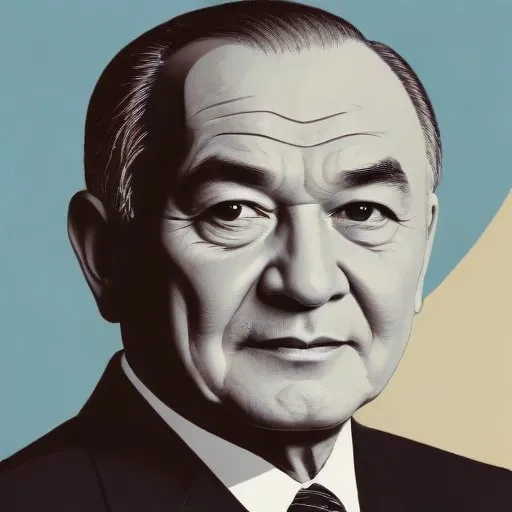
First President of Uzbekistan, ruling from 1991 until his death in 2016, known for his authoritarian regime and human rights abuses. He maintained a tight grip on power and suppressed opposition.
Islam Karimov is widely recognized as the founding father of modern Uzbekistan, leading the country to independence from Soviet rule in 1991. Throughout his 25-year reign, he left an indelible mark on the nation's politics, economy, and society, albeit often marred by authoritarianism and human rights abuses.
Karimov was born on January 30, 1938, in Samarkand, Uzbekistan, to civil servant parents. His early life was marked by turmoil, with stints in an orphanage before eventually graduating from high school in 1955. He went on to earn a degree in mechanical engineering from the Central Asian Polytechnic Institute (now Tashkent State Technical University) in 1960.
Karimov's professional journey began as an engineer, later joining the Ministry of Water Resources of the Uzbek Soviet Socialist Republic. He furthered his education with a master's degree in economics from Tashkent State University in 1967.
Karimov's political ascendance began in 1989, when he became the First Secretary of the Communist Party of Uzbekistan. Following the collapse of the Soviet Union, he declared Uzbekistan's independence on August 31, 1991, and won the country's first presidential election on December 29, 1991, with an overwhelming 86% of the vote.
Although his presidency was marked by criticisms of voting irregularities and human rights abuses, Karimov remained in power, winning subsequent elections in 2000, 2007, and 2015, each time securing over 90% of the vote.
Karimov's tenure was marred by allegations of political repression, human rights violations, and media censorship. Political opponents were often persecuted, and dissent was suppressed. While he abolished capital punishment in 1998, his regime remained notorious for its brutal treatment of opposition figures and human rights activists.
Karimov's leadership had a profound impact on Uzbekistan's economy, politics, and culture. He oversaw significant infrastructure development, including the construction of new roads, bridges, and public buildings. He also promoted Uzbek nationalism, revitalizing the country's cultural heritage and language.
Despite his authoritarian rule, Karimov remains a polarizing figure in Uzbekistan. While some hail him as a national hero, others condemn his human rights record and accuse him of suppressing democracy.
"Uzbekistan is a nation with a rich history and a bright future. We must work together to build a prosperous and democratic society."
Karimov passed away on September 2, 2016, leaving behind a complex and multifaceted legacy that continues to shape Uzbekistan's trajectory.
