


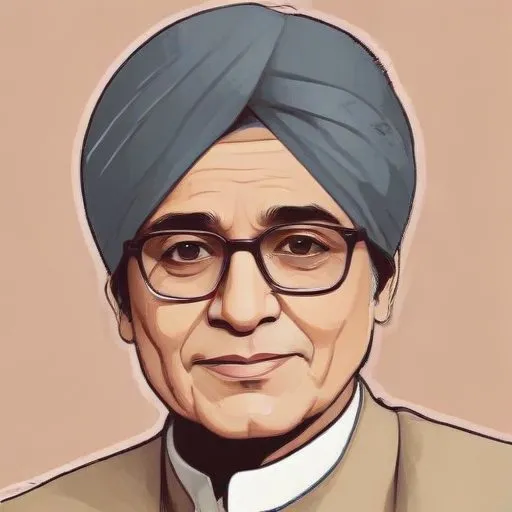
Indian politician who served as a member of the Rajya Sabha and was a key figure in the Indian National Congress, known for his contributions to Indian politics and social reform.
Jagjit Singh Lyallpuri, a stalwart of Indian politics, is renowned for his unwavering commitment to the Communist Party of India (Marxist) and his relentless pursuit of social justice. As the oldest surviving member of the founding Central Committee of the CPI(M), Lyallpuri's life was a testament to his unshakeable conviction in the power of collective struggle.
Born on April 10, 1917, in Lyallpur, Punjab (present-day Faisalabad, Pakistan), Lyallpuri was exposed to the harsh realities of colonial rule and social inequality from a young age. His family, having lost their landholdings of roughly 150-180 acres due to the Partition of India, instilled in him a sense of responsibility towards the downtrodden.
Lyallpuri's involvement in the student movement in the 1930s sparked his interest in politics, and he joined the Indian National Congress at the age of 18. Despite his parents' initial reluctance towards his entry into politics, he pursued his passion, earning a BSc from Khalsa College in Amritsar and later an LLB from the Government Law College in Lahore in 1940.
Lyallpuri's association with the Kirti Kisan Party, a radical peasant organization, marked a turning point in his political career. He became a professional revolutionary and a key figure in the Punjab Kisan Sabha, later merging into the Communist Party of India. His leadership skills and commitment to the cause earned him a place in the Central Committee of the party.
In the aftermath of Partition, Lyallpuri relocated to Ludhiana, where he continued to champion the cause of peasants and workers. He opposed B.T. Ranadive's line of launching guerrilla struggles, advocating instead for mass mobilization and peaceful agitation.
Jagjit Singh Lyallpuri's life was a testament to his unwavering commitment to the principles of social justice, equality, and democracy. Through his activism, leadership, and perseverance, he inspired generations of Indians to fight for their rights and challenge the status quo.
As we remember Lyallpuri, we are reminded of the power of collective struggle and the importance of standing up against oppression. His legacy serves as a beacon of hope, inspiring us to continue the fight for a more just and equitable society.
"Revolution is not a onetime event, but a continuous process. It's the collective effort of the people that can bring about real change."
"The struggle for social justice is not a destination, but a journey. We must be prepared to face challenges and overcome obstacles along the way."
Lyallpuri was recognized for his contributions to the Indian freedom struggle and his commitment to social justice. He was awarded the Padma Bhushan, one of India's highest civilian honors, in 2005.
