


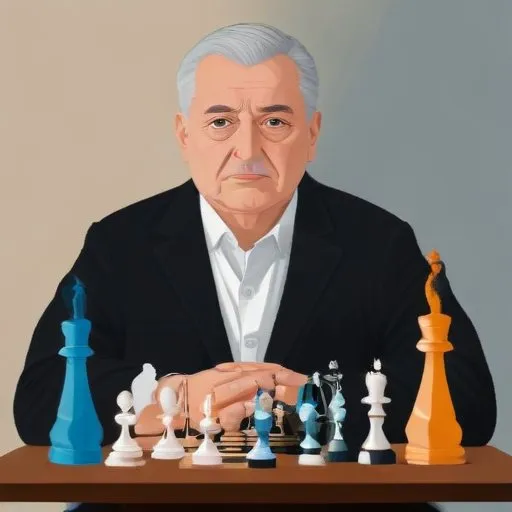
A Ukrainian-German mathematician, chess player, and academic who made significant contributions to algebraic geometry and was a chess master. He's known for his work on invariant theory and its applications.
Jakob Rosanes was a renowned German mathematician who made significant contributions to algebraic geometry and invariant theory. A chess master in his free time, Rosanes' work had a profound impact on the development of mathematics in the late 19th and early 20th centuries.
Born on August 16, 1842, in Germany, Rosanes came from a family of Jewish scholars. His grandfather, Rabbi Akiva Eiger, was a prominent figure in Talmudic studies and halachic decisors. Rosanes' mother, Baila, was Eiger's daughter. Despite his family's strong religious roots, Rosanes grew up during a time of Enlightenment and increasing assimilation, leading him to adopt a more secular lifestyle.
Rosanes pursued higher education at the University of Berlin and later at the University of Breslau, where he earned his doctorate in 1865. He went on to teach at the University of Breslau for the remainder of his academic career, eventually becoming a professor in 1876 and rector of the university from 1903 to 1904.
Rosanes' most notable contributions were in the field of Cremona transformations, a crucial area of algebraic geometry. His work laid the foundation for future mathematicians to build upon, significantly advancing the field.
In addition to his mathematical prowess, Rosanes was an exceptional chess player. He engaged in several notable games with Adolf Anderssen, one of the strongest players of his time. Although Anderssen often emerged victorious, Rosanes occasionally managed to beat him, showcasing his exceptional skill.
Jakob Rosanes' legacy extends beyond his mathematical contributions. He played a significant role in shaping the academic landscape of his time, influencing generations of mathematicians to come. His work continues to inspire researchers and scholars today.
Rosanes' achievements earned him recognition and respect from his peers. He was a respected figure in the academic community, holding prominent positions within the University of Breslau.
Rosanes' children converted to Christianity, a reflection of the changing times and social attitudes towards religion. Despite his own secular lifestyle, Rosanes remained connected to his Jewish heritage through his family ties.
Jakob Rosanes' remarkable life and achievements serve as a testament to the power of human ingenuity and dedication. His contributions to mathematics and chess continue to inspire and influence people to this day.
Born in 1882
A pioneering mathematician and physicist who revolutionized abstract algebra and made groundbreaking contributions to modern physics, particularly in the development of Einstein's theory of general relativity.
Born in 1862
A renowned mathematician and academic who developed infinite-dimensional vector spaces and laid the foundation for quantum mechanics and relativity. He's also famous for his 23 unsolved math problems that shaped 20th-century mathematics.
Born in 1849
A pioneer in geometry and group theory, known for developing the Erlangen program, which unified various geometries under a single framework. His work laid foundations for modern algebraic geometry and topology.
Born in 1854
A pioneer in mathematics and physics, he laid the foundations for modern chaos theory, topology, and relativity, making groundbreaking contributions to our understanding of space and time.
Born in 1838
A 19th-century mathematician who made significant contributions to group theory, particularly in the development of the Jordan-Holder theorem, and was one of the first to introduce abstract algebraic concepts.
Born in 1823
A pioneer in number theory, this mathematician developed the concept of ideals and contributed significantly to the development of modern algebra. Their work laid the foundation for many mathematical advancements.
Born in 1831
Developed a rigorous definition of real numbers and introduced the concept of Dedekind cuts, revolutionizing mathematics and laying the foundation for modern analysis. His work also explored the nature of infinity and the foundations of mathematics.
Born in 1845
Developed set theory, introducing infinite sets and cardinal numbers, revolutionizing mathematics and philosophy.
