


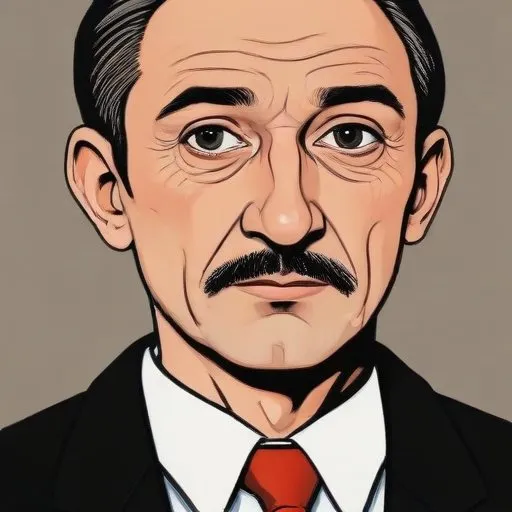
A Hungarian-Serbian writer who penned influential works of fiction, exploring themes of identity, culture, and social change in the Balkans. His writings continue to resonate with readers today.
Jakov Ignjatovi is renowned for being a prolific novelist and prose writer, primarily penning his works in Serbian, with some Hungarian writings thrown into the mix. His literary contributions have left an indelible mark on the cultural landscape of Vojvodina, a region in modern-day Serbia.
Born on December 8, 1822, in Szentendre, Ignjatovi completed his elementary education in his hometown before moving on to study at the Gymnasium in Vác, Esztergom, and Pest. He later enrolled in Law School at Pest, but his academic pursuits were put on hold when he joined the hussars.
A romantic at heart, Ignjatovi was swept up in the Hungarian Revolution of 1848, fighting against the Austrians alongside Hungarian forces. This decision went against the grain, as most Serbs and Croats in Austria at the time sided with the empire. His activism led to a brief stint in prison when the revolution was suppressed.
After his release, Ignjatovi fled to Belgrade, where he worked as a journalist until 1850. He then embarked on a journey around the world, eventually returning to Hungary in 1853. Back in Hungary, he became an active participant in the cultural and political life of Serbs in Vojvodina.
Ignjatovi's writing career was marked by his editorship of several prominent publications, including Letopis Matice srpske (Serbian Annals), Srpske novine (Serbian News), and Nedeljni list (Weekend Magazine), between 1854 and 1856. His literary works showcased his dedication to promoting the interests of Slav and Romanian nationalities in the Austrian dominions.
Ignjatovi's involvement in politics led to controversies, particularly when he joined Svetozar Miletić's People's Party, fighting against Austrian rule. However, when the party split with Hungary, Ignjatovi chose to remain loyal to the Hungarian authorities, a decision that alienated him from his compatriots and led to him being viewed as a traitor. He spent the rest of his life in relative isolation.
Despite the controversies surrounding his life, Ignjatovi's literary contributions remain a testament to his dedication to promoting Serbian culture and identity. His works continue to inspire generations of writers and scholars, cementing his place as a pioneering figure in Serbian literature.
Born in 1893
A renowned Croatian literary figure, celebrated for his diverse and influential works that explored the human condition, social critique, and philosophical themes.
