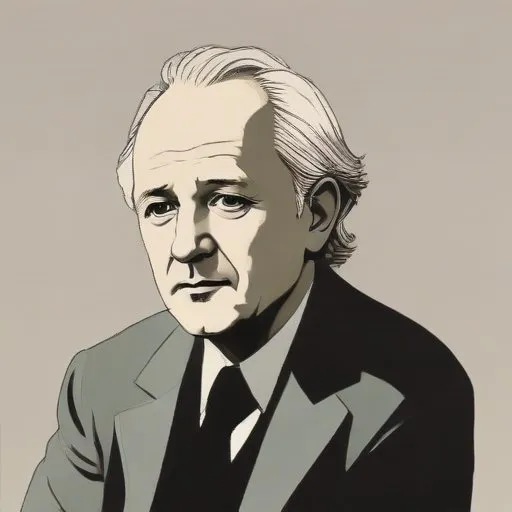
James Dickey: The Poet Laureate Behind Deliverance
A Legacy of Turbulent Beauty
James Dickey, the 18th United States Poet Laureate, is renowned for his novel
Deliverance, a gripping tale of four men's fateful journey down Georgia's Cahulawassee River. Adapted into a critically acclaimed film in 1972, Dickey's literary masterpiece has become an iconic representation of American literature.
A Turbulent Early Life
Born on February 2, 1923, in Atlanta, Georgia, Dickey's early life was marked by a complex mix of privilege and turmoil. His father, Eugene Dickey, was a successful lawyer, while his mother, Maibelle Swift, struggled with mental health issues. Dickey's experiences at North Fulton High School and Darlington School in Rome, Georgia, left an indelible mark on his worldview, evident in his later writing.
War, Education, and the Pursuit of Knowledge
Dickey's life took a dramatic turn during World War II, where he served in the U.S. Army Air Forces as a P61 Black Widow radar operator. His 38 missions in the Pacific Theater earned him five Bronze Stars, an experience that would later inform his writing. After the war, Dickey attended Vanderbilt University, where he earned a degree in English and philosophy, as well as a minor in astronomy. He later received an M.A. in English from Vanderbilt in 1950.
A Career of Words and Wisdom
Dickey's teaching career spanned several institutions, including Rice University, the University of Florida, and Baylor University. His passion for literature and philosophy inspired generations of students, while his own writing continued to flourish. Dickey's appointment as the 18th United States Poet Laureate in 1966 cemented his position as a leading voice in American literature.
Major Works and Awards
Dickey's literary repertoire includes:
- Deliverance (1970) - a novel that catapulted him to fame
- Helmets (1964) - a collection of poems that explores the human condition
- Buckdancer's Choice (1965) - a poetry collection that earned him the National Book Award
Dickey's work has been recognized with numerous awards, including the Order of the South and the Guggenheim Fellowship.
Controversies and Public Perception
Dickey's life was not without controversy. His outspoken views on politics and society often sparked debate, and his perceived machismo image has been subject to criticism. Despite these controversies, Dickey's literary contributions remain unparalleled, and his influence on modern American literature is undeniable.
Philosophical Contributions and Beliefs
Dickey's writing often grappled with the human condition, exploring topics such as masculinity, violence, and the American South. His philosophy was rooted in a deep appreciation for nature and a fascination with the darker aspects of human nature.
Legacy and Impact on Modern Society
James Dickey's legacy extends far beyond his literary works. His poetry and novels have inspired generations of writers, including authors such as
Cormac McCarthy and
Larry McMurtry. Dickey's influence on modern American literature is a testament to his boundless creativity and intellectual curiosity.
Personal Milestones and Key Life Events
Dickey's life was punctuated by significant events, including:
- 1941: Graduated from North Fulton High School
- 1942: Enlisted in the U.S. Army Air Forces
- 1949: Graduated from Vanderbilt University with a degree in English and philosophy
- 1950: Received an M.A. in English from Vanderbilt University
- 1966: Appointed as the 18th United States Poet Laureate
Dickey's remarkable journey, marked by both turmoil and triumph, has left an indelible mark on American literature. His poetry and novels continue to captivate readers, offering a glimpse into the workings of a complex and brilliant mind.
FAQ
What was James Dickeys most famous literary work?
James Dickey is best known for his novel Deliverance, which was published in 1970 and adapted into a critically acclaimed film in 1972.
What awards did James Dickey win for his writing?
James Dickey won several awards for his writing, including the National Book Award for Poetry in 1966 for his collection Buckdancers Choice.
How did James Dickey get involved in writing?
James Dickey began writing poetry as a teenager, and went on to study literature and philosophy at Vanderbilt University and the University of California, Berkeley.
What was James Dickeys literary style like?
James Dickeys writing was known for its lyricism, intensity, and exploration of themes such as nature, identity, and the human condition.
Did James Dickey have any notable influences or contemporaries?
James Dickey was influenced by poets such as William Faulkner and Robert Lowell, and was a contemporary of writers such as Sylvia Plath and John Berryman.