


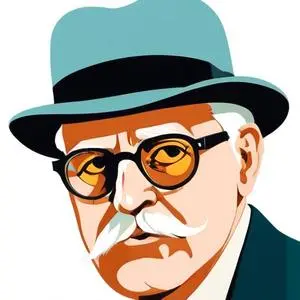
A pioneering modernist writer, known for experimental novels and short stories that explore the human experience, particularly in Dublin, Ireland. His works are celebrated for their complex, lyrical prose and innovative narrative structures.
James Joyce is renowned for his pioneering work in modernist literature, leaving an indelible mark on the literary world with his groundbreaking novels, poetry, and criticism. His seminal work, Ulysses, is hailed as a landmark of modernist fiction, employing innovative stream-of-consciousness narration that redefined the art of storytelling.
Born on February 2, 1882, in Dublin, Ireland, Joyce was raised in a middle-class family and attended Jesuit schools, where he developed a passion for literature and languages. He graduated from University College Dublin in 1902 and soon after met his future wife, Nora Barnacle, with whom he escaped to mainland Europe, settling in Trieste, Austria-Hungary.
In Trieste, Joyce began to flourish as a writer, publishing his first book of poetry, Chamber Music, in 1907. His short story collection, Dubliners, followed in 1914, showcasing his mastery of the genre. The same year, he started serially publishing A Portrait of the Artist as a Young Man in the English magazine The Egoist, which would become his first novel.
During World War I, Joyce and his family relocated to Zurich, Switzerland, where he worked on his magnum opus, Ulysses. After the war, he returned to Trieste, then moved to Paris in 1920, which became his primary residence until 1940. In Paris, he found solace among the city's avant-garde circles and continued to produce some of his most iconic works.
Ulysses was first published in Paris in 1922, but its publication in the United Kingdom and the United States was initially prohibited due to its perceived obscenity. Undeterred, Joyce's work gained momentum, and he went on to publish Finnegans Wake in 1939, a novel that would cement his reputation as a literary genius.
Joyce's impact on modern literature is immense. His innovative use of language, stream-of-consciousness narration, and exploration of the human condition have influenced generations of writers, including Samuel Beckett, Virginia Woolf, and Jorge Luis Borges, among many others. Today, he is regarded as one of the most important writers of the 20th century, and his works continue to be widely read and studied around the world.
Joyce received widespread recognition for his contributions to literature. He was awarded the Prix Balzac in 1934 and was nominated for the Nobel Prize in Literature multiple times.
Joyce's personal life was marked by a deep love for his wife, Nora, and their children, Giorgio and Lucia. His relationships with writers and intellectuals, such as Ezra Pound and Sylvia Beach, played a significant role in shaping his literary career.
Born in 1885
A pioneering modernist poet and critic who transformed 20th-century literature with innovative styles and provocative ideas, shaping the course of modern poetry.
Born in 1882
A pioneering author of modernist literature, known for experimental novels and essays that explored the human experience, blurring the lines between reality and fiction.
Born in 1888
A renowned poet, playwright, and critic who reshaped modern poetry with works like "The Waste Land" and "Old Possum's Book of Practical Cats", influencing literature and art with their unique style.
Born in 1896
Author of novels and short stories that capture the essence of the Jazz Age, exploring themes of wealth, class, and the American Dream. Known for timeless classics like "The Great Gatsby" and "Tender Is the Night".
Born in 1899
A legendary writer who crafted sparse, powerful prose, capturing the human experience in novels like "The Old Man and the Sea" and "A Farewell to Arms".
Born in 1874
A pioneering figure in modernist literature, known for experimental writing styles and influential salons that fostered artistic innovation. 82
Born in 1873
A pioneering modernist writer, credited with influencing 20th-century literature through experimental novels and poetry that explored the human condition. Known for his impressionistic style and complex characters.
Born in 1882
A pioneering figure in the Vorticist movement, creating avant-garde paintings and writings that critiqued modern society, blending art and literature.
