


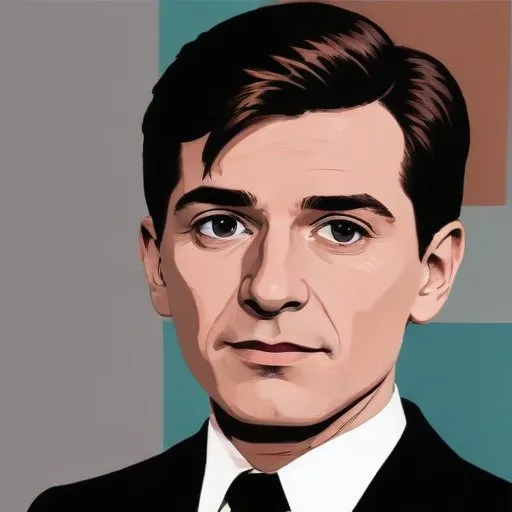
Developed the concept of "Rational Emotive Behavior Therapy" (REBT), a form of psychotherapy that helps individuals identify and change negative thought patterns. He wrote numerous books on psychology and self-help.
James Kennedy, an American social psychologist, is renowned for pioneering the groundbreaking concept of particle swarm optimization (PSO), a problem-solving algorithm inspired by human social interaction. Since the early 1990s, Kennedy's work has spawned tens of thousands of research papers, solidifying his position as a leading figure in the field of artificial intelligence.
In 1995, Kennedy, along with Russell C. Eberhart, presented the first papers on PSO, revolutionizing the way we approach complex problem-solving. By integrating social psychological simulation research with evolutionary computation methods, Kennedy and Eberhart created a novel algorithm that harnesses the power of collective intelligence.
The PSO algorithm operates on the principles of human social interaction, where individuals share their successes with their topological neighbors, facilitating a collaborative learning process. As the program runs, the population converges on optimal vectors, providing a reliable solution to complex problems. This decentralized approach has been demonstrated to be effective in solving complex problems, particularly in distributed systems.
Kennedy's influence extends beyond the realm of PSO. As an active advocate for social justice, he has been involved in controversies surrounding sex education and gender identity, fighting for inclusive and progressive values. Additionally, Kennedy has pursued a successful career as a professional musician, releasing albums with his band, The Colliders, and exploring the roots of rock and roll.
Born on November 5, 1950, Kennedy's journey has been marked by a commitment to innovation and progress. His work on PSO has earned him recognition within the scientific community, with his book, Swarm Intelligence, co-authored with Eberhart and Yuhui Shi, becoming a seminal work in the field.
Kennedy's work is underpinned by a deep understanding of human social behavior and the potential for collective intelligence to drive innovation. His advocacy for progressive values reflects his commitment to promoting inclusivity and social justice.
The impact of Kennedy's work on PSO is undeniable, with applications in fields such as robotics, engineering, and computer science. His contributions have paved the way for the development of more sophisticated algorithms, driving technological advancements and shaping the future of artificial intelligence.
"The power of the swarm lies in its ability to converge on optimal solutions, often in ways that defy human intuition."
"Social psychology has much to offer the development of artificial intelligence, and vice versa."
James Kennedy's work on particle swarm optimization has left an indelible mark on the scientific community, inspiring a new generation of researchers and practitioners. His contributions continue to shape the field of artificial intelligence, driving innovation and progress in various domains.
James Kennedy's remarkable career is a testament to the power of innovation and interdisciplinary collaboration. As we continue to navigate the complexities of the 21st century, Kennedy's work serves as a reminder of the potential for collective intelligence to drive progress and shape the future.
Born in 1904
Developed the theory of operant conditioning, which explores the relationship between behavior and environment, and invented the "Skinner box" to study learning and behavior.
Born in 1879
Founded the school of behaviorism, which focused on observable behaviors rather than internal thoughts or feelings, and is known for his controversial "Little Albert" experiment.
Born in 1925
Developed the theory of social learning, which suggests that people learn new behaviors by observing and imitating others, and is known for his Bobo doll experiment.
Born in 1896
Developed groundbreaking theories on child cognitive development and learning, emphasizing active discovery and hands-on experience. His work has shaped modern education and parenting practices.
Born in 1902
Developed the theory of psychosocial development, which proposes that individuals go through eight stages of development from infancy to old age, each with its own unique challenges and opportunities. His work has had a significant impact on our understanding of human development and identity formation.
Born in 1856
Pioneering psychoanalyst who developed theories on the subconscious mind, childhood experiences, and the structure of personality, revolutionizing our understanding of human behavior and psychology.
Born in 1875
Developed the concept of collective unconscious and archetypes, and founded analytical psychology, which emphasizes the integration of opposites and the process of individuation.
