


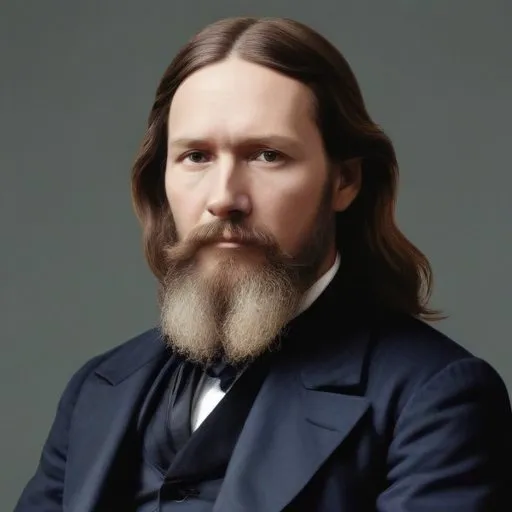
A prominent poet and critic of the 19th century, known for his satirical and abolitionist writings that influenced American literature and politics. His poetry often explored themes of social justice and morality.
James Russell Lowell, one of America's most prominent Romantic poets, critics, editors, and diplomats, is renowned for his fervent advocacy against slavery and his remarkable literary contributions that rivaled the popularity of British poets. His fiery writings and impassioned oratory style earned him a distinct place among the fireside poets, a group of New England writers who captivated American audiences with their conventional forms and meters.
Lowell was born on February 22, 1819, in Cambridge, Massachusetts. He graduated from Harvard College in 1838, despite his reputation as a troublemaker, and went on to earn a law degree from Harvard Law School. This educational foundation laid the groundwork for his later success as a writer, critic, and diplomat.
Lowell's first collection of poetry was published in 1841, marking the beginning of his literary career. His marriage to Maria White in 1844 further solidified his commitment to abolition, as she was an ardent abolitionist herself. Together, they had several children, though only one survived past childhood.
Lowell's poetry became a powerful medium for expressing his anti-slavery views. He took a job in Philadelphia, Pennsylvania, as the editor of an abolitionist newspaper, using his platform to speak out against the injustices of slavery. His satirical poem, A Fable for Critics (1848), lampooned contemporary critics and poets, while The Biglow Papers (1848) cemented his reputation as a literary force.
After Maria's passing in 1853, Lowell accepted a professorship of languages at Harvard in 1854. He traveled to Europe before assuming his teaching duties in 1856 and married Frances Dunlap in 1857. That same year, he became editor of The Atlantic Monthly, a position he held for over 20 years.
Lowell's diplomatic career took off when he was appointed ambassador to the Kingdom of Spain in 1877, followed by a stint as ambassador to the Court of St. James's. He spent his later years in Cambridge, passing away on August 12, 1891, in the same estate where he was born.
Lowell's poetry and writings reflect his strong stance against slavery and his commitment to social justice. He believed in the power of literature to shape public opinion and bring about positive change. Through his work, he sought to humanize the experiences of enslaved individuals and expose the brutal realities of slavery.
Lowell's literary legacy extends beyond his own lifetime. He influenced generations of American writers, including Mark Twain and Emily Dickinson. His poetry and essays continue to be studied and admired for their lyricism, wit, and social commentary. As a pioneer of American literature, Lowell's contributions to the abolitionist movement and his literary excellence have left an indelible mark on American cultural heritage.
Born in 1803
A leading figure in the Transcendentalist movement, he advocated for individualism, self-reliance, and nature-inspired spirituality through his essays and poetry. His ideas continue to influence American thought and culture.
Born in 1817
A 19th-century thinker who advocated for simple living, civil disobedience, and individualism, inspiring generations to reevaluate their relationship with nature and society.
Born in 1819
A celebrated poet, essayist, and journalist who revolutionized American literature with his collection "Leaves of Grass", known for his free verse style and celebration of the human spirit.
Born in 1830
A reclusive poet who crafted innovative, enigmatic, and emotionally charged verse that continues to captivate readers with its unique style and profound insights.
Born in 1809
A master of dark and atmospheric storytelling, crafting haunting tales of mystery and horror that continue to captivate readers to this day.
Born in 1819
Author of epic sea tales and philosophical explorations, including the iconic "Moby-Dick", which continues to influence literature and popular culture.
Born in 1804
Author of dark, psychologically complex tales that explore the human condition, often set in 17th-century New England, and known for his masterpiece "The Scarlet Letter".
Born in 1835
Witty writer of classics like "The Adventures of Tom Sawyer" and "The Adventures of Huckleberry Finn", known for humor and social commentary.
