


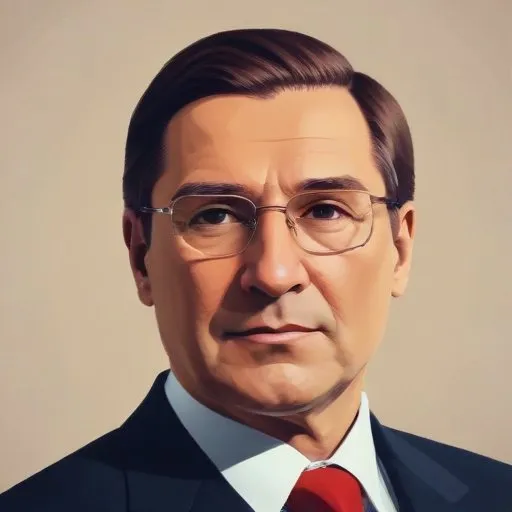
Slovenia's second president, a key figure in the country's transition to independence and democracy, known for his economic reforms and leadership during a tumultuous period.
Janez Drnovek was a Slovenian liberal politician who left an indelible mark on his country's history, serving as the President of the Presidency of Yugoslavia from 1989 to 1990, Prime Minister of Slovenia from 1992 to 2002, and President of Slovenia from 2002 to 2007. Throughout his illustrious career, Drnovek navigated Slovenia's transition from communism to democracy, earning him the reputation as a shrewd and visionary leader.
Born on May 17, 1950, in Celje, Slovenia, Drnovek was raised in the small town of Kisovec, where his father Viktor was the local mine chief and his mother Silva was a homemaker. He graduated from the University of Ljubljana with a degree in economics in 1973, which laid the foundation for his future success.
Drnovek's early career was marked by stints as an intern at a Le Havre bank, chief financial officer at SGP Beton Zagorje, and economic adviser at the Yugoslav embassy in Cairo. He defended his master's thesis in 1981 and his dissertation at the Faculty of Economics and Business at the University of Maribor in 1986.
In 1983, Drnovek became the head of the local branch of Ljubljana Bank in his home region of the Central Sava Valley. His leadership skills and economic expertise soon caught the attention of the Slovenian Communist Party, which chose him as a delegate at the Slovenian Republic Assembly and the Chamber of Republics and Provinces of the Yugoslav parliament in 1986.
In 1989, Drnovek's rising star propelled him to the position of President of the Presidency of Yugoslavia, following a controversial election where he defeated the Party's preferred candidate, Marko Bulc. This unexpected victory marked a significant shift in Slovenia's political landscape, as Drnovek became the first Slovenian representative to the Collective Presidency of Yugoslavia to be elected through a democratic process.
Drnovek's tenure as Prime Minister of Slovenia from 1992 to 2002 was marked by significant economic reforms, including the introduction of a new Slovenian currency, the tolar, and Slovenia's accession to the European Union in 2004. During this period, he also navigated Slovenia through a brief constitutional crisis in 2000, which ultimately led to his resignation.
However, Drnovek's political fortunes revived in 2002, when he was elected as the President of Slovenia, a position he held until 2007. During his presidency, Drnovek focused on strengthening Slovenia's international relations, particularly within the European Union, and solidifying its position as a stable and prosperous democracy.
Drnovek's legacy is complex and multifaceted, reflecting both his achievements and controversies. Critics have accused him of being aloof and dismissive of opposition voices, while supporters praise his visionary leadership and economic reforms.
Despite these controversies, Drnovek remains an important figure in Slovenian history, credited with guiding his country through a tumultuous period of transition and laying the foundations for its modern prosperity.
Drnovek married his wife, Sonja, in 1976, and they had two children together. He was known for his love of literature and was an avid reader of Slovenian literature.
Drnovek's passing on February 23, 2008, was met with widespread tributes from Slovenian politicians and international leaders, recognizing his significant contributions to Slovenia's transformation.
Through his remarkable career, Janez Drnovek left an indelible mark on Slovenian politics, earning his place as one of the most important figures in modern Slovenian history.
85 Years Old
First President of Slovenia, leading the country to independence from Yugoslavia in 1991, and shaping its early years as a sovereign nation.
80 Years Old
A Slovenian politician and diplomat who served as the country's Foreign Minister and played a key role in Slovenia's accession to the European Union and NATO. He's known for his efforts in promoting Slovenian independence and international cooperation.
74 Years Old
A Slovene academic and politician who served as the 3rd President of Slovenia, known for his contributions to the country's transition to democracy and independence from Yugoslavia. He played a key role in shaping Slovenia's foreign policy and international relations.
62 Years Old
The 4th President of Slovenia, a lawyer-turned-politician who served two terms from 2012 to 2022, known for his efforts to strengthen Slovenia's economy and international relations.
63 Years Old
Served as the Prime Minister of Slovenia from 2014 to 2018, known for his efforts to stabilize the country's economy and implement reforms. Led a center-left government coalition, focusing on social welfare and education.
