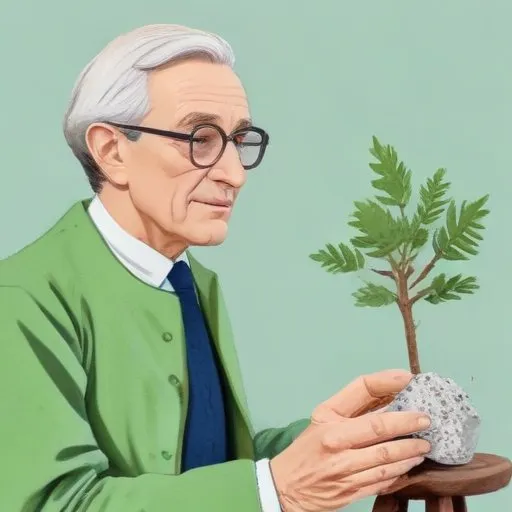
Jeantienne Guettard: The Pioneering French Naturalist and Mineralogist
A Legacy of Geological Discovery
Jeantienne Guettard is renowned for his groundbreaking contributions to the fields of natural history, mineralogy, and geology. Born on September 22, 1715, in Tampes, near Paris, Guettard's fascination with the natural world led him to become one of the most influential scientists of his era, laying the foundation for modern geological mapping and the study of mineral distribution.
Early Life and Education
Guettard's interest in botany was sparked during his boyhood, thanks to the guidance of his grandfather, an apothecary. He later pursued a degree in medicine, qualifying as a doctor in 1740. This early exposure to the natural world and his academic background in medicine laid the groundwork for his subsequent forays into botany, mineralogy, and geology.
Major Contributions and Discoveries
Guettard's most significant achievement was the creation of the first geological map in 1746, which showcased his observations on the distribution of minerals and rocks across France. This pioneering work was presented to the Academy of Sciences in Paris and marked the beginning of geological cartography. His research also delved into the relationship between plant distribution and soil composition, leading him to explore the fields of mineralogy and geology.
- He was one of the first scientists to recognize the existence of former volcanoes in the Auvergne region of France.
- Guettard's work on the degradation of mountains by rain, rivers, and sea helped shape our understanding of geological processes.
Publishing and Recognition
Guettard's publications include:
- Observations sur les plantes (2 vols, 1747)
- Histoire de la découverte faite en France de matières semblables à celles dont la porcelaine de la Chine est composée (1765)
- Mémoires sur différentes parties des sciences et arts (5 vols, 1768-1783)
- Mémoires sur la minéralogie du Dauphiné (2 vols, 1779)
- Atlas et description minéralogiques de la France (1780)
- Atlas minéralogique de la France, volume de planches (1780)
In recognition of his contributions, Guettard was elected a foreign member of the Royal Swedish Academy of Sciences in 1759.
Legacy and Impact
Guettard's work has had a lasting impact on the fields of geology, mineralogy, and natural history. His pioneering efforts in geological mapping paved the way for future generations of scientists. The Dorsum Guettard, a wrinkle ridge on the Moon, was named in his honor, a testament to his enduring influence on the scientific community.
FAQ
What was Jean-Étienne Guettards contribution to the field of mineralogy?
Jean-Étienne Guettard made a significant contribution to the field of mineralogy, as he was one of the first scientists to classify minerals based on their chemical composition.
How did Jean-Étienne Guettards work influence the development of geology?
Jean-Étienne Guettards work had a profound impact on the development of geology, as it helped to establish the field as a distinct scientific discipline.
What was Jean-Étienne Guettards role in the French Academy of Sciences?
Jean-Étienne Guettard played a significant role in the French Academy of Sciences, as he was one of the institutions most prominent members and made significant contributions to its work.
What was Jean-Étienne Guettards most notable discovery?
Jean-Étienne Guettards most notable discovery was the identification of the mineral kaolin, which is a key component of ceramics and paper.
Who was Jean-Étienne Guettard influenced by?
Jean-Étienne Guettard was influenced by a range of scientific figures, including René-Antoine Ferchault de Réaumur and Bernard de Jussieu.