


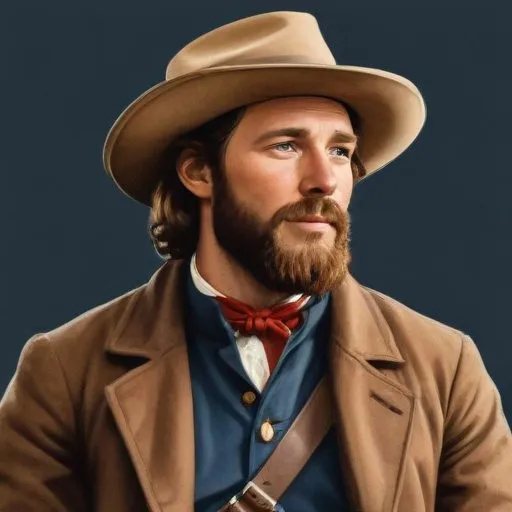
A legendary figure in the early American West, he blazed trails, mapped territories, and wrote about his daring adventures, leaving an indelible mark on the country's exploration and settlement.
Jedediah Strong Smith, a name synonymous with bravery, resilience, and exploration, is renowned for being the first American to venture into the Western United States, mapping the Continental Divide, and blazing a trail for pioneers on the Oregon Trail. His remarkable journeys, marked by grit and determination, forever changed the course of American history.
Born on January 6, 1799, in New York, Smith came from a modest family background. His thirst for adventure led him to St. Louis, where he joined William H. Ashley and Andrew Henry's fur trading company in 1822. This marked the beginning of his illustrious career as a mountain man, trapper, and explorer.
In 1826, Smith led the first documented exploration from the Salt Lake frontier to the Colorado River. His party was the first to traverse the treacherous Mojave Desert into what is now the state of California, then part of Mexico. This groundbreaking journey demonstrated Smith's unwavering courage and skill, earning him a reputation as a trailblazer.
The following year, Smith and his companions became the first U.S. citizens to travel north from California overland to the Oregon Country. This remarkable feat not only solidified his position as a leading explorer but also paved the way for future pioneers.
Smith's expeditions were not without danger. He survived three Native American massacres and one bear mauling, a testament to his unbreakable spirit and determination. These harrowing experiences only strengthened his resolve to chart the unexplored territories of the American West.
In March 1831, Smith requested a federally funded exploration of the West, submitting a comprehensive map of the region derived from his own journeys. Although the request was denied, his work would later inspire and guide countless explorers, settlers, and pioneers.
On May 27, 1831, while searching for water in present-day southwest Kansas, Smith disappeared during an encounter with the Comanche. His body was never recovered, leaving behind a legacy of adventure, discovery, and bravery that would be remembered for generations to come.
Smith's expeditions were motivated by a deep sense of curiosity and a desire to explore the unknown. His writings and maps demonstrate a profound respect for the natural world and its inhabitants, inspiring later generations to adopt a more sustainable approach to exploration and settlement.
Smith's groundbreaking expeditions and cartographic work laid the foundation for the development of the American West. His pioneering spirit and unwavering determination have inspired countless individuals to pursue careers in exploration, conservation, and environmentalism.
Smith's life was marked by incredible feats of bravery, resilience, and determination. From surviving Native American massacres to mapping the Continental Divide, his expeditions left an indelible mark on the history of the American West.
"I am now not only a citizen of the United States, but a citizen of the world, and I will do my best to make all nations respect America." - Jedediah Smith
These words, spoken by Smith in 1827, reflect his unwavering patriotism, sense of adventure, and commitment to exploration and discovery.
After 75 years of relative obscurity following his death, Smith was rediscovered as the American whose explorations led to the use of the 20-mile wide South Pass as the dominant route across the Continental Divide for pioneers on the Oregon Trail. His legacy has since been cemented as one of the most significant figures in American exploration and history.
Smith's expeditions and achievements stand alongside those of other prominent explorers of the era, including John Jacob Astor and Kit Carson. While each of these individuals contributed significantly to the development of the American West, Smith's unwavering bravery, cartographic skills, and respect for the natural world set him apart as a pioneering figure in American history.
Smith's expeditions, while groundbreaking in scope, also had an unintended impact on the environment. The introduction of European settlers and the exploitation of natural resources led to the displacement of Native American communities and the degradation of the natural environment. Today, we recognize the importance of adopting sustainable practices and respecting the delicate balance of ecosystems, a lesson that can be learned from Smith's legacy.
Through his remarkable journeys and cartographic work, Jedediah Smith left an indelible mark on the history of the American West. His bravery, resilience, and determination continue to inspire generations, reminding us of the importance of exploration, conservation, and sustainable practices in the pursuit of a better future for all.
Born in 1763
A German-American mogul who built a fur trading empire and invested in real estate, amassing a vast fortune, which he later used to support the arts and education.
Born in 1809
Famous frontiersman and explorer who led expeditions through the American West, known for his bravery and role in the Mexican-American War.
Born in 1804
Fur trader and explorer who blazed trails through the American West, discovering the Great Salt Lake and opening up the Oregon Trail to settlers.
Born in 1774
Led the Corps of Discovery expedition with William Clark, mapping the western United States and establishing trade with Native American tribes. Known for his bravery, leadership, and contributions to American exploration and expansion.
75 Years Old
A renowned blues harmonica virtuoso, known for his soulful, expressive playing style and influential recordings that helped shape the sound of Chicago blues.
Born in 1779
Led expeditions to explore and map the American West, including the discovery of Pikes Peak, and played a key role in the War of 1812.
