


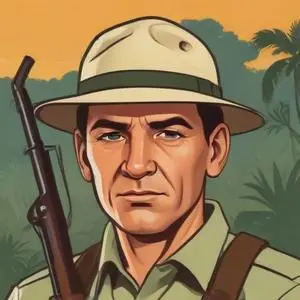
A legendary tiger hunter turned conservationist, who wrote vivid stories about his jungle adventures, later advocating for wildlife preservation and national parks.
Jim Corbett, the renowned Anglo-Indian hunter, tracker, and naturalist, is famously known for his fearless endeavors in ridding the Indian villages of man-eating tigers and leopards, earning him a reputation as a savior to the people of Kumaon and Garhwal Divisions. His remarkable hunting skills and exceptional writing talent have immortalized his name in the annals of Indian history, with his literary masterpiece, Man-Eaters of Kumaon, remaining a timeless classic.
Born on July 25, 1875, in Naini Tal, India, Jim Corbett was the eighth of nine children to Christopher William Corbett, a postmaster, and Mary Jane Doyle Corbett. His family's roots traced back to the British Isles, with his paternal grandparents, Joseph and Harriet Corbett, having eloped to India in 1815. Growing up in the scenic hill station of Naini Tal, Corbett developed a deep love for nature and an affinity for the wilderness that would shape his future endeavors.
Corbett's exceptional tracking and hunting skills were honed from a young age, which soon earned him the respect and recognition of the British colonial administration. Between 1907 and 1947, he was summoned by the Government of the United Provinces of Agra and Oudh to eliminate man-eating tigers and leopards that terrorized villages, claiming numerous human lives. His unwavering courage and unorthodox methods made him a legendary figure, with his hunts recounted in vivid detail in his books.
Jim Corbett's literary exploits are as impressive as his hunting feats. His debut book, Man-Eaters of Kumaon, published in 1944, became an instant bestseller, followed by The Man-Eating Leopard of Rudraprayag, The Temple Tiger and More Man-Eaters of Kumaon, and Tree Tops. His writing not only showcased his exceptional storytelling skills but also raised awareness about the need to protect India's wildlife from extinction.
In recognition of Corbett's achievements, the Indochinese tiger subspecies was named Panthera tigris corbetti in his honor. Today, the Jim Corbett National Park in Uttarakhand, India, stands as a testament to his unwavering dedication to wildlife conservation. His legacy extends beyond India, inspiring generations of wildlife enthusiasts, conservationists, and writers.
Corbett never married and remained a humble and private individual, despite his fame. His love for photography and his talent for capturing the essence of India's wildlife on camera are often overlooked aspects of his remarkable life. An intriguing anecdote about Corbett's life is his role as a mentor to the then-young Mahatma Gandhi, whom he introduced to the concept of wildlife conservation.
In conclusion, Jim Corbett's remarkable life serves as a beacon of inspiration, showcasing the perfect blend of bravery, compassion, and conservation. His contribution to Indian history and his impact on modern society are undeniable, making him an iconic figure in the annals of Indian wildlife conservation.
Born in 1902
Acclaimed cinematographer behind iconic films like "Lawrence of Arabia" and "Doctor Zhivago", capturing breathtaking landscapes and intimate moments with innovative camera techniques.
