


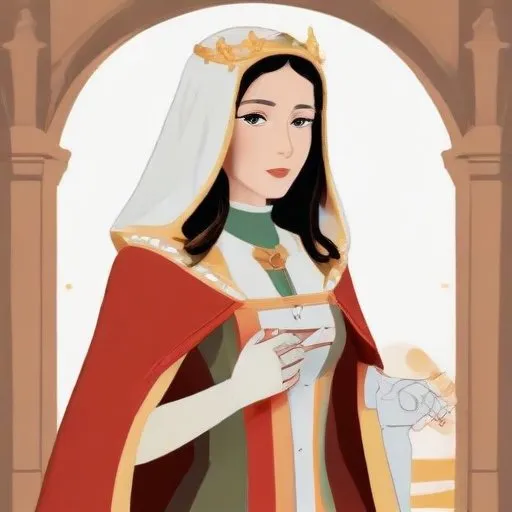
A 13th-century noblewoman who ruled Auvergne, a region in south-central France, and played a significant role in the country's medieval politics. She's known for her strategic marriages and alliances that shaped the region's history.
Joan I, Countess of Auvergne, reigned supreme over the counties of Auvergne and Boulogne from 1332 to 1360, leaving an indelible mark on the annals of European history. As the wife of King John II of France, she became Queen Consort, cementing her position as one of the most powerful women of the 14th century.
Born on May 8, 1326, in the Château d'Argilly, Joan was the daughter of William XII, Count of Auvergne and Boulogne, and Margaret, a sister of Philip III of Navarre. Her life was marked by a series of strategic marriages and alliances, which would shape the fate of her realms and her family.
Upon her father's death, Joan inherited the counties of Auvergne and Boulogne, becoming one of the most coveted prizes in medieval Europe. Her first marriage to Philip of Burgundy, Count of Auvergne, solidified her position, but it was her second marriage to John, Duke of Normandy, that catapulted her to the pinnacle of power.
Following John's ascension to the French throne as King John II, Joan became Queen Consort on August 22, 1350. As queen, she wielded significant influence, navigating the complexities of royal politics with ease. Her son, Philip, became a ward of the king, ensuring her family's future prospects.
Joan had several children with both her husbands, including Philip I of Burgundy, Margaret, and Joan, who was engaged to Amadeus VI of Savoy. Her brief but tumultuous life was marked by personal tragedy, including the loss of her children and the struggle to secure her family's legacy.
Joan passed away on September 29, 1360, leaving behind a rich legacy that would shape the course of French history. Her possessions were inherited by her son, Philip, ensuring the continuation of the Auvergne and Boulogne dynasties.
Joan I, Countess of Auvergne, may not have left behind grand monuments or sweeping reforms, but her life and legacy have had a lasting impact on the trajectory of European politics and history. As a testament to her enduring influence, her story continues to captivate and inspire, a testament to the power and resilience of women in the medieval era.
Though few direct quotes from Joan I, Countess of Auvergne, have survived the test of time, her actions and decisions speak volumes about her strength, determination, and unwavering commitment to her family and realm.
Joan's life can be seen as a microcosm of the tumultuous 14th century, marked by wars, plague, and shifting alliances. Her legacy serves as a testament to the complex web of relationships that shaped medieval politics and the enduring power of women in the face of adversity.
As we delve into the life and times of Joan I, Countess of Auvergne, we are reminded of the intricate dance of power, politics, and personal relationships that defined the medieval era. Her story serves as a powerful reminder of the enduring influence of women in shaping the course of history.
Born in 1319
King of France from 1350 to 1364, known for being captured by the English during the Hundred Years' War and later ransomed.
Born in 1052
King of France from 1060 to 1108, known for his military campaigns and conflicts with the Church, particularly his excommunication by Pope Urban II.
Born in 1273
The queen who ruled Navarre and married into the French monarchy, known for her diplomatic efforts to maintain peace between her husband's kingdom and her own. She played a significant role in shaping the politics of medieval Europe.
Born in 1338
The King of France from 1364 to 1380, known for his military victories and rebuilding of Paris, earning him the nickname "Charles the Wise".
Born in 1710
The monarch who ruled France from 1715 to 1774, known as the "Sun King's" great-grandson, and remembered for his extravagance, absolutism, and the decline of the French monarchy.
Born in 1052
King of France from 1060 to 1108, known for his military campaigns and conflicts with the Church, particularly his excommunication by Pope Urban II.
