


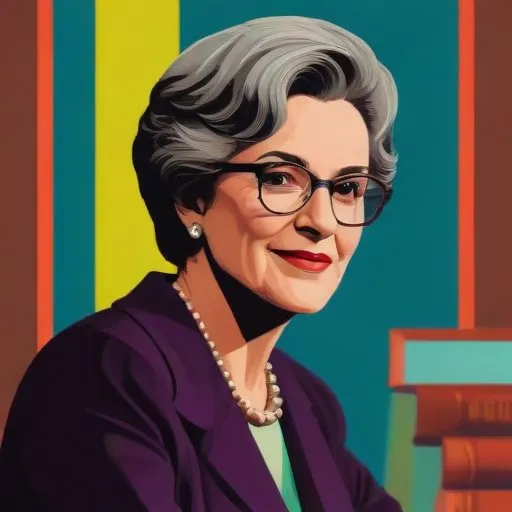
A renowned historian and feminist scholar, she is most known for her groundbreaking work on gender and its intersection with power, politics, and social structures. Her influential writings have reshaped the field of history and beyond.
Joan Wallach Scott is renowned for her groundbreaking contributions to feminist history and gender theory, revolutionizing the field of historical analysis with her innovative approaches to understanding power, language, and identity. As a prominent American historian of France, Scott has dedicated her career to exploring the intricacies of gender and its far-reaching implications on society.
Born on December 18, 1941, in Brooklyn, New York, to high school teachers Lottie (née Tannenbaum) and Sam Wallach, Scott's early life instilled in her a passion for learning and a commitment to social justice. She pursued higher education, earning her degrees from the University of Wisconsin–Madison and the University of Chicago.
Scott's illustrious academic career has spanned several esteemed institutions, including the University of Illinois at Chicago, Northwestern University, the University of North Carolina at Chapel Hill, and Brown University. Her tenure at Brown University saw her serving as the founding director of the Pembroke Center for Teaching and Research on Women, where she began exploring the intersection of theory and gender.
Her most influential work, the 1986 article "Gender: A Useful Category of Historical Analysis," published in the American Historical Review, has been widely read and cited, playing a pivotal role in shaping the field of gender history within the Anglo-American historical profession. This seminal work has had a profound impact on the way historians approach the study of gender and its significance in understanding historical events.
Scott's theoretical contributions have been instrumental in shaping the discourse on gender, power, and language. She has consistently challenged conventional notions of power, arguing that it is not solely held by individuals but is instead a complex web of relationships and discursive practices. Her work has also emphasized the importance of understanding the role of historians in shaping our perceptions of the past.
Scott's philosophical beliefs are rooted in her commitment to feminist ideals and her conviction that historical analysis should be informed by a nuanced understanding of the interconnectedness of power, language, and identity. Her work has inspired a new generation of scholars to rethink the ways in which we approach the study of history.
Scott's work has far-reaching implications for modern society, influencing the way we think about gender, power, and identity. Her ideas have permeated popular culture, informing feminist movements and inspiring new perspectives on social justice. Her contributions have also had a significant impact on academic fields beyond history, influencing disciplines such as sociology, anthropology, and literary theory.
Scott's trailblazing work has been recognized with numerous awards and honors, including the Nancy Duke Lewis University Professorship at Brown University and the Harold F. Linder Professorship at the Institute for Advanced Study. She has also received honorary degrees from several institutions, acknowledging her profound impact on the academic community.
Throughout her distinguished career, Scott has navigated the challenges of being a woman in a male-dominated field, persevering to become a leading voice in her discipline. Her personal milestones are a testament to her unwavering dedication to her work and her commitment to creating a more just and equitable society.
In conclusion, Joan Wallach Scott's remarkable contributions to feminist history and gender theory have left an indelible mark on the academic community and beyond. Her groundbreaking work continues to inspire and challenge scholars, shaping our understanding of power, language, and identity in profound and lasting ways.
Born in 1920
Pioneering historian and author who uncovered and shared the stories of women's lives and contributions throughout history, shedding light on their often-overlooked roles and achievements.
Born in 1908
A pioneering feminist philosopher who wrote extensively on ethics, politics, and gender, famously arguing that "one is not born, but rather becomes, a woman."
Born in 1921
Pioneering feminist author who wrote "The Feminine Mystique," a groundbreaking book that sparked the modern women's liberation movement by challenging traditional gender roles. Known for inspiring a generation of women to demand equal rights and opportunities.
92 Years Old
A pioneering figure in the feminist movement, co-founding the Women's Media Center to promote women's voices and representation in media. Known for her tireless advocacy and inspiring leadership.
Born in 1924
A trailblazing African American congresswoman who broke racial and gender barriers, advocating for education, women's rights, and the poor. She was the first woman to run for the Democratic presidential nomination in 1972.
Born in 1902
Pioneering geneticist who discovered transposons, mobile genetic elements that jump from one location to another in a genome, revolutionizing our understanding of genetic variation and evolution.
93 Years Old
A pioneering Supreme Court Justice and women's rights advocate who championed gender equality and became a cultural icon.
96 Years Old
First female Supreme Court Justice in the United States, serving from 1981 to 2006 and playing a crucial role in many landmark cases, particularly those involving gender equality and reproductive rights.
