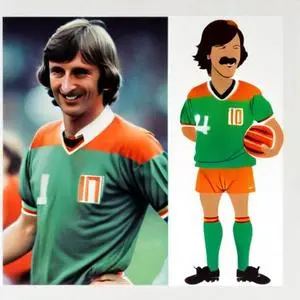
Johan Cruyff: The Visionary Who Revolutionized Football
A Pioneering Spirit and Unmatched Success
Johan Cruyff is revered as one of the greatest players in football history, with a trifecta of Ballon d'Or awards (1971, 1973, and 1974) and a lasting impact on the sport that continues to inspire new generations. As a mastermind of the pitch, Cruyff's innovative playing style and coaching philosophies have left an indelible mark on the game, earning him recognition as one of the most influential figures in modern football.
Early Years and Rise to Prominence
Born Hendrik Johannes Cruijff on April 25, 1947, in Amsterdam, Netherlands, Cruyff began his football journey at Ajax, where he would go on to win eight Eredivisie titles, three European Cups, and one Intercontinental Cup. His remarkable skills on the field, which included speed, agility, and exceptional vision, earned him a reputation as a trailblazer in the sport.
Total Football and the Dutch Golden Era
Cruyff was a key proponent of the Total Football philosophy, developed by his mentor
Rinus Michels, which emphasized flexibility, creativity, and individual freedom on the pitch. This revolutionary approach catapulted the Netherlands to unprecedented success, with Cruyff leading the team to the final of the 1974 FIFA World Cup, where he claimed the Golden Ball as player of the tournament.
A Continental Force: Ajax and Barcelona
In 329 matches for Ajax, Cruyff scored an astonishing 257 goals and provided over 170 assists, cementing his status as a goal-scoring phenomenon. His move to Barcelona in 1973, for a then-world record transfer fee, further solidified his legend, as he helped the team win La Liga in his first season and claimed yet another Ballon d'Or. Over 180 official matches for Barcelona, he netted 60 goals and furnished 83 assists, leaving an enduring legacy at the Catalan club.
Coaching Career and Legacy
After retiring from playing in 1984, Cruyff transitioned seamlessly into coaching, guiding Ajax to unprecedented success and later taking the reins at Barcelona. His management style, which emphasized youth development, attacking flair, and a commitment to the Total Football ethos, elevated both clubs to new heights. Cruyff's influence extends beyond his own teams, as his philosophies have inspired a generation of coaches and players worldwide.
Awards and Accolades
- Three-time Ballon d'Or winner (1971, 1973, and 1974)
- European Player of the Century (1999)
- FIFA World Cup Golden Ball winner (1974)
- UEFA Best Player in Europe (1997)
The Man Behind the Legend
Off the pitch, Cruyff was known for his humility, kindness, and generosity. He was a devoted family man and a passionate advocate for social causes, particularly in the realm of education and youth development. Cruyff's love for the beautiful game was matched only by his love for life itself, and his unwavering dedication to his craft continues to inspire countless individuals around the world.
Legacy and Impact
Johan Cruyff's legacy extends far beyond his on-field achievements. He has left an indelible mark on the sport, shaping the very fabric of football with his innovative playing style, coaching philosophies, and commitment to youth development. As a visionary, Cruyff continues to inspire future generations, ensuring that his influence will be felt for years to come.
FAQ
What is Johan Cruyffs legacy in football?
Johan Cruyff is widely regarded as one of the greatest football players of all time, known for his innovative style of play and his influence on the development of the game. He is credited with revolutionizing the sport with his concept of total football.
What were Johan Cruyffs achievements as a player?
Johan Cruyff won numerous titles with Ajax and the Netherlands national team, including three Ballon dOr awards. He is best known for his iconic goal in the 1974 World Cup and his leadership of the Dutch team to the final.
What is Johan Cruyffs coaching legacy?
Johan Cruyff had a successful coaching career, leading Barcelona to four consecutive La Liga titles and winning the European Cup in 1992. He is credited with developing the tiki-taka style of play that became synonymous with Barcelona.
What is Johan Cruyffs impact on modern football?
Johan Cruyffs influence can be seen in modern football, with many teams and players adopting his total football philosophy. He is widely regarded as one of the greatest coaches and players of all time.
What is Johan Cruyffs legacy off the pitch?
Johan Cruyff was a beloved figure off the pitch, known for his charitable work and his advocacy for social justice. He was a vocal critic of corruption in football and was involved in various humanitarian initiatives.