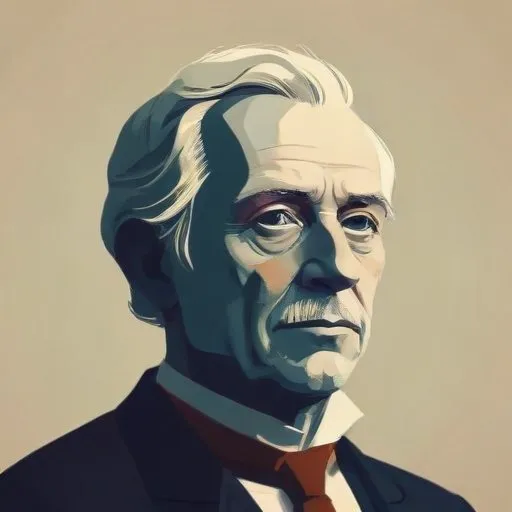
Johan Vilhelm Snellman: The Beacon of Finnish Nationalism
A Philosophical Statesman and Awakener of Finnish Identity
Johan Vilhelm Snellman is revered as one of the most influential figures in Finnish history, renowned for his tireless efforts in promoting Finnish nationalism and shaping the country's cultural identity. As a philosopher, statesman, and educator, Snellman's contributions paved the way for Finland's evolution into a modern, autonomous nation.
Early Life and Education
Born on May 12, 1806, in Stockholm, Sweden, Snellman's family relocated to Kokkola, Finland, in 1813, following the Russian conquest of Finland. His mother, Maria Magdalena Snellman, passed away shortly after the move. Snellman's educational pursuits took him to the Royal Academy of Turku, where he studied theology, history, literature, and natural sciences from 1822 to 1828.
Academic Career and National Romanticism
Snellman's academic career unfolded at the University of Helsinki, where he was appointed lecturer in 1835. His lectures, imbued with nationalist sentiments, captivated students and earned him a reputation as a charismatic orator. During this period, Snellman was part of the esteemed circle of Cygnaeus, Lnnrot, and Runeberg, comprising the brightest minds of their generation. His academic work was heavily influenced by Hegel, but he diverged from romanticism by focusing on the future and spiritual activity of nations.
Exile and Return
In 1838, Snellman's lectureship was temporarily revoked due to a judicial proceeding aimed at curbing oppositional thought among academics. This led to his self-imposed exile in Sweden and Germany from 1839 to 1842. Upon his return to Helsinki, his popularity had swelled, but the political climate did not permit his re-employment at the university.
Philosophical Contributions and Beliefs
Snellman's philosophical framework emphasized the importance of national identity, language, and culture. He believed that a nation's spiritual activity was the driving force behind its progress and development. His ideas resonated with the Finnish people, inspiring a sense of national pride and unity.
Influence on Modern Society
Snellman's legacy extends far beyond his academic pursuits. He is credited with awakening Finnish nationalism, paving the way for Finland's eventual independence from Russia in 1917. His emphasis on the importance of the Finnish language and culture continues to shape the country's cultural landscape.
Personal Milestones and Key Life Events
- Ennobled in 1866, recognizing his contributions to Finnish society
- Returned to Helsinki in 1842, after a four-year exile in Sweden and Germany
- Appointed lecturer at the University of Helsinki in 1835
Quotes and Memorable Sayings
- "The nation's spiritual activity is the source of its power and greatness."
- "The Finnish language is the foundation of our national identity."
Legacy and Comparative Analysis
Snellman's influence is comparable to that of Elias Lnnrot and J.L. Runeberg, fellow promoters of Finnish nationalism. His philosophical contributions continue to inspire Finnish scholars and thinkers, solidifying his position as a beacon of Finnish cultural identity.
Visual Timeline and Milestones
| Year |
Event |
| 1806 |
Birth in Stockholm, Sweden |
| 1813 |
Family relocates to Kokkola, Finland |
| 1822-1828 |
Studies at the Royal Academy of Turku |
| 1835 |
Appointed lecturer at the University of Helsinki |
| 1838 |
Lectureship revoked, leading to exile in Sweden and Germany |
| 1842 |
Returns to Helsinki after four-year exile |
| 1866 |
Ennobled for his contributions to Finnish society |
| 1881 |
Passes away on July 4th |
Snellman's life and work serve as a testament to the power of nationalism and the importance of cultural identity. His legacy continues to inspire generations of Finns, solidifying his place as a pioneer in Finnish history.
FAQ
What is Johan Vilhelm Snellmans significance in Finnish history?
Snellman was a Finnish philosopher and politician who played a key role in the development of Finnish nationalism. He advocated for Finnish autonomy and cultural identity within the Russian Empire.
How did Johan Vilhelm Snellmans philosophical ideas shape Finnish nationalism?
Snellmans philosophical ideas emphasized the importance of national identity, language, and culture. He believed that Finns should assert their autonomy and develop their own cultural institutions.
What was Johan Vilhelm Snellmans role in the Finnish language movement?
Snellman was a key figure in the Finnish language movement, advocating for the use of Finnish as an official language and promoting its development as a literary language.
How did Johan Vilhelm Snellmans politics reflect his philosophical views?
Snellmans politics were shaped by his philosophical views on national identity and autonomy. He believed in the importance of gradual reform and cooperation with the Russian authorities to achieve Finnish autonomy.
What is Johan Vilhelm Snellmans legacy in Finnish politics?
Snellmans legacy is one of commitment to Finnish nationalism and cultural identity. He played a key role in shaping Finnish politics and contributed to the growth of Finnish autonomy within the Russian Empire.