


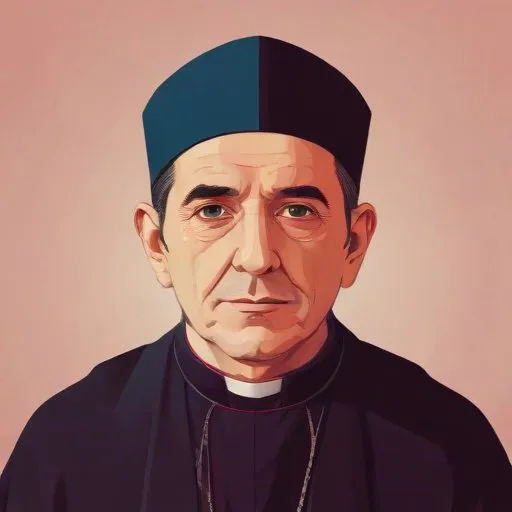
Austrian priest who founded the Congregation of the Sisters of Mercy and dedicated his life to serving the poor and marginalized. He's revered for his selfless charity and compassion.
Johann Gruber, affectionately known as "Papa Gruber," was an Austrian Roman Catholic priest who risked everything to help his fellow prisoners survive during one of humanity's darkest periods. From 1940 until his tragic death in 1944, Gruber was imprisoned in Concentration Camp Gusen I, where he demonstrated unwavering compassion and selflessness, earning him the title "The Saint of Gusen."
Born on October 20, 1889, in Tegernbach, Austria, Gruber's life was marked by a strong sense of faith and a desire to serve others. After his parents' passing, he attended the Petrinum Linz, a Catholic private school, where he received his Matura. In 1910, he joined the seminary in Linz, eventually becoming a priest.
Gruber's intellectual pursuits didn't stop there. He went on to study philosophy in Vienna, earning his PhD in 1923. He then became a teacher and director of an institution for the blind in Linz, dedicating his life to helping others.
In 1938, after Austria's annexation into the German Reich, Gruber was arrested for speaking out against the National Socialist regime. Despite the Nazi press launching a vicious smear campaign against him, accusing him of sexually abusing pupils, Gruber remained resolute in his opposition.
After serving two years in prison, Gruber was sent to Dachau concentration camp and later to Gusen concentration camp. It was here that he continued to serve others, participating in an archaeological project outside the camp and using his connections to send money and support to his fellow prisoners.
In Gusen, Gruber's selflessness knew no bounds. He bribed SS men and kapos to deliver food to starving inmates, using his own funds to support those in need. His actions, however, did not go unnoticed. On April 4, 1944, Gruber was discovered, interrogated, and tortured for three days. His body was later found hanged on a nearby tree, with the official cause of death listed as suicide.
In 2016, the criminal court in Vienna reversed Gruber's conviction, finally clearing his name of the false accusations. Today, Gruber is remembered as a hero, a symbol of hope and compassion in the face of unimaginable cruelty.
His legacy serves as a powerful reminder of the importance of standing up against injustice, even in the face of overwhelming oppression. Johann Gruber's selfless acts will continue to inspire generations to come, a testament to the enduring power of the human spirit.
Johann Gruber's courageous story is a beacon of hope, reminding us that even in the darkest of times, humanity can prevail. His legacy will continue to inspire and motivate others to stand up against injustice, just as he did, and to embody the values of compassion, empathy, and selflessness.
Born in 1778
Romantic-era writer of fantastical and often dark tales, exploring themes of love, death, and the supernatural. His works are considered precursors to modern fantasy literature.
Born in 1765
A German philosopher and theologian who merged Catholic mysticism with German Idealism, influencing 19th-century thought on spirituality and social reform.
