


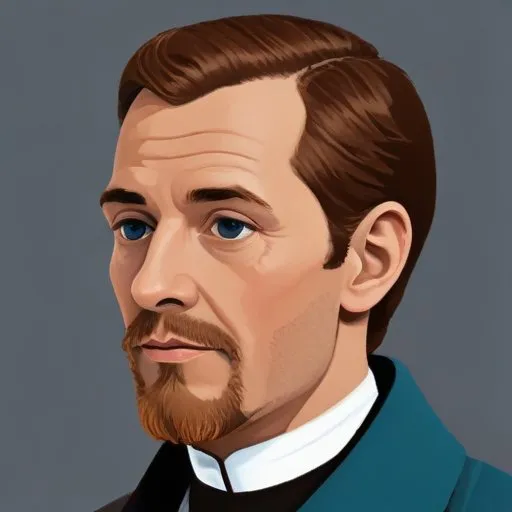
A Scottish-English physician and polymath who made significant contributions to mathematics, astronomy, and literature, and is best known for creating the character of John Bull, a symbol of England.
John Arbuthnot, a Scottish physician, satirist, and mathematician, is best known for his profound contributions to the realms of mathematics and literature, as well as his creation of the iconic figure of John Bull, a symbol of England.
Born in Arbuthnot, Kincardineshire, Scotland, on April 29, 1667, Arbuthnot was the son of Rev. Alexander Arbuthnot, an Episcopalian priest, and Margaret Lammie. After completing his early education, he may have graduated with an arts degree from Marischal College in 1685.
In 1691, Arbuthnot relocated to London, where he would eventually become a prominent figure in the city's intellectual circles. His exceptional abilities in mathematics, medicine, and literature earned him recognition and respect among his contemporaries.
Arbuthnot's work in mathematics was multifaceted and influential. His treatise on probability, Of the Laws of Chance, co-authored with Pierre Remond de Montmort, was a groundbreaking study that laid the foundation for later mathematicians.
In addition to his mathematical endeavors, Arbuthnot was an accomplished satirist and writer. As a member of the illustrious Scriblerus Club, he collaborated with notable figures such as Alexander Pope and Jonathan Swift, inspiring works like Gulliver's Travels and The Dunciad.
One of Arbuthnot's most enduring legacies is the creation of John Bull, a quintessential symbol of England. Through his character, Arbuthnot cleverly satirized English politics and society, providing a lasting impact on British popular culture.
Throughout his life, Arbuthnot exhibited humility and conviviality, often downplaying his own achievements. His friends and contemporaries frequently complained that he did not receive sufficient credit for his work. This humility was reflected in his reluctance to leave a biography, famously stating, "Biography is one of the new terrors of death."
John Arbuthnot's contributions to mathematics, literature, and satire have had a lasting impact on modern society. His work continues to inspire scholars, writers, and thinkers, cementing his place as one of the most important polymaths of the 17th and 18th centuries.
John Arbuthnot's life and work are a testament to the intellectual fervor of the 17th and 18th centuries. His influence on mathematics, literature, and satire continues to be felt, ensuring his place as a prominent figure in the history of ideas.
As a polymath, Arbuthnot embodied the spirit of his time, pushing the boundaries of human knowledge and creativity. His remarkable achievements serve as a reminder of the power of intellectual curiosity and the enduring impact of innovative thinking.
Born in 1667
A witty wordsmith who penned scathing social commentaries, including the iconic "Gulliver's Travels", which continue to delight and provoke readers to this day.
82 Years Old
A German-Canadian singer-songwriter, guitarist, and producer, known for his eclectic style blending rock, folk, and blues, and as the frontman of the rock band Steppenwolf. He's famous for hits like "Born to Be Wild" and "Magic Carpet Ride".
Born in 1676
The first Prime Minister of the United Kingdom, serving from 1721 to 1742, known for establishing the office of Prime Minister and setting important precedents for the role. He is also recognized for his skill in managing Parliament and his role in shaping British politics.
Born in 1656
Predicted celestial events, including the return of a comet that bears his name, and made significant contributions to navigation, astronomy, and mathematics.
Born in 1390
Brother of King Henry V and uncle of King Henry VI, he was a powerful nobleman and patron of the arts, known for his intellectual pursuits and literary patronage.
Born in 1683
King of Great Britain and Ireland from 1727 to 1760, known for his military victories, particularly the Battle of Dettingen, and his role in the War of the Austrian Succession.
