


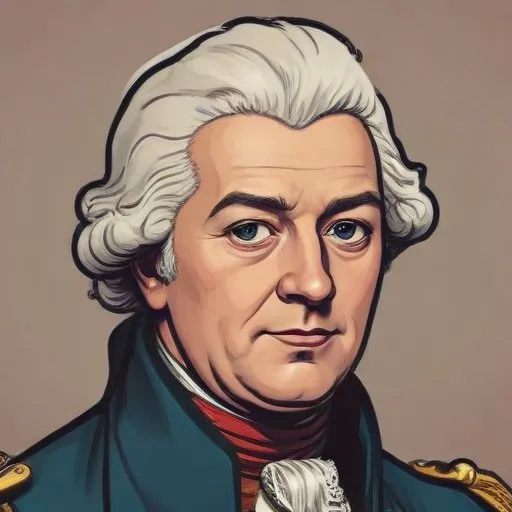
Led British forces during the American Revolutionary War, ultimately surrendering at Saratoga, a turning point in the war. He was also a playwright and politician.
Known for his ill-fated invasion of New York from Canada during the American Revolutionary War, John Burgoyne is a figure of great significance in American and British history. His surrender at Saratoga in 1777 marked a turning point in the war, paving the way for French intervention and ultimately, American independence.
Born on February 24, 1722, Burgoyne was a British army officer, dramatist, and politician. He saw action during the Seven Years' War, participating in several battles, including the Portugal campaign of 1762. His early military career was marked by bravery and strategic thinking, earning him recognition and promotion.
In 1777, Burgoyne designed an invasion scheme to split New England from the rest of the colonies, hoping to end the rebellion. He advanced from Canada, but his slow movement allowed American forces to concentrate and prepare for battle. Despite being outnumbered, the American forces, led by General Horatio Gates, inflicted significant casualties on Burgoyne's army, forcing him to surrender at Saratoga on October 17, 1777.
The surrender at Saratoga had far-reaching consequences, both for Burgoyne personally and for the outcome of the war. It led to a significant shift in British public opinion, with many questioning the wisdom of continuing the war. The defeat also convinced France to ally with the Americans, providing them with much-needed financial and military support. According to historian Edmund Morgan, the surrender at Saratoga was a "great turning point" of the war, ultimately leading to American victory.
In addition to his military career, Burgoyne was an accomplished playwright, penning works such as The Maid of the Oaks and The Heiress. Although his plays never achieved the same level of recognition as his military exploits, they demonstrate his creative and intellectual abilities.
After his surrender, Burgoyne returned to England, where he faced criticism and scrutiny. However, with the rise of the Shelburne ministry in 1782, he experienced a brief revival in his military career, serving as commander-in-chief of crown forces in Ireland. Despite this, his active service ended with the return of the Tories to power in 1784. Burgoyne passed away on August 4, 1792, leaving behind a legacy as a complex and multifaceted figure, remembered for his bravery, strategic thinking, and literary talents.
John Burgoyne's life and legacy serve as a testament to the complexities of war, politics, and human nature. His story continues to fascinate and inspire, offering valuable insights into the events that shaped the modern world.
Born in 1741
A traitorous American general who defected to the British Army during the American Revolutionary War, leading to a pivotal moment in American history.
Born in 1732
The first President of the United States, a military hero who led the country to independence, and set the standard for the office of the presidency. He's known for his honesty, integrity, and leadership skills.
79 Years Old
A Pulitzer Prize-winning composer, known for blending minimalism with complex rhythms, creating a unique sound that resonates with audiences worldwide.
Born in 1743
The principal author of the Declaration of Independence and a strong advocate for individual liberties and limited government, shaping America's foundational principles. He oversaw the Louisiana Purchase, doubling the country's territory.
Born in 1706
A founding father of the United States, he was a leading figure in the Enlightenment, known for his groundbreaking inventions, scientific discoveries, and influential writings. He played a key role in shaping American history and politics.
