


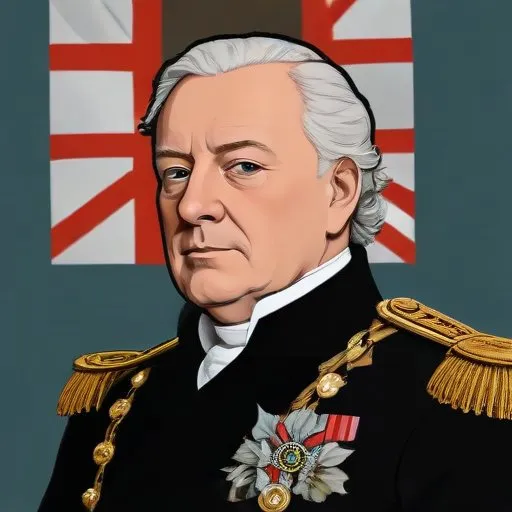
An 18th-century naval officer who governed Newfoundland and was court-martialed for failing to engage the enemy, leading to reforms in the British Navy's rules of engagement. He's infamous for being the first British admiral executed for cowardice.
Admiral John Byng is infamously remembered as the British Royal Navy officer who was court-martialed and executed by firing squad in 1757. His downfall was a result of his failure to relieve a besieged British garrison during the Battle of Minorca at the beginning of the Seven Years War.
John Byng was born on October 29, 1704, at Southill Park in Bedfordshire, England. He was the fourth son of Rear-Admiral Sir George Byng, a highly skilled naval commander who had won distinction in several battles and was held in esteem by the monarchs he served.
Byng joined the Royal Navy at the tender age of 13, following in his father's footsteps. He participated in the Battle of Cape Passaro in 1718 and gradually built a reputation as a solid naval officer over the next three decades. His career saw him rise through the ranks, and he was promoted to Vice-Admiral in 1747.
Byng served as Commodore-Governor of Newfoundland Colony in 1742 and Commander-in-Chief, Leith, from 1745 to 1746. He was also a member of Parliament from 1751 until his death.
In 1756, Byng was tasked with relieving a besieged British garrison on the island of Minorca, which was under attack by a French fleet. He sailed for Minorca with a hastily assembled fleet, some of which were in poor condition. The ensuing battle off the Minorcan coast resulted in Byng's defeat, and his fleet suffered significant damage.
Instead of continuing to fight, Byng chose to return to Gibraltar to repair his ships. This decision would ultimately prove to be his undoing. Upon his return to Britain, Byng was court-martialed and found guilty of failing to do his utmost to prevent Minorca from falling to the French.
Byng was sentenced to death, and despite pleas for clemency, he was shot dead by a firing squad on March 14, 1757. His tragic tale serves as a cautionary reminder of the high stakes involved in military command and the unforgiving nature of wartime politics.
Byng's legacy is complex and multifaceted. While his failure at Minorca and subsequent execution are well-documented, his earlier achievements as a naval officer and his contributions to British naval history should not be overlooked.
Byng's failure at Minorca and his subsequent execution sparked controversy and public debate. Many saw his punishment as harsh and unjust, while others viewed it as a necessary consequence of his actions.
The Byng affair highlighted the tensions between military commanders and politicians during wartime and raised questions about the nature of command and responsibility.
Born in 1738
The British monarch who ruled during the American Revolution, losing the colonies, and later suffered a mental illness that led to a regency crisis. He's also known for his cultural and artistic patronage.
Born in 1749
A prominent 18th-century politician who championed individual liberties and opposed British imperialism, known for his charismatic oratory skills and influential foreign policy decisions.
