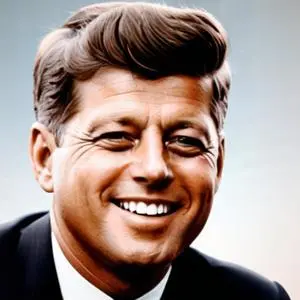
John F. Kennedy

John F. Kennedy

John F. Kennedy was born on May 29th, 1917

Full Name: John Fitzgerald Kennedy
Profession: 35th President of the United States
Place of Birth: Brookline, Massachusetts
Zodiac Sign: Scorpio
Spouse: Jacqueline Kennedy
Children: Caroline Kennedy, John Jr.
Education: Harvard University
Notable Achievements: Leader of the Free World

The 35th President of the United States was a charismatic leader who navigated the country through the Cuban Missile Crisis and advocated for civil rights, leaving a lasting legacy in American politics.

Written by: Thomas Blackwood Thomas Blackwood

John F. Kennedy: The Charismatic Leader Who Captivated a Nation

A Presidency Marked by Courage and Vision

John F. Kennedy, the 35th President of the United States, is iconic for his unwavering resolve in the face of adversity, his remarkable leadership during the Cold War era, and his enduring legacy that continues to inspire generations. Kennedy's presidency, though cut short by his untimely assassination in 1963, left an indelible mark on American history, cementing his place as one of the most beloved and respected leaders of the 20th century.

Early Life and Career

Born on May 29, 1917, in Brookline, Massachusetts, Kennedy was the second of nine children to Joseph P. Kennedy Sr. and Rose Fitzgerald Kennedy. He graduated from Harvard University in 1940, following which he joined the U.S. Naval Reserve. During World War II, Kennedy commanded PT-109, a patrol torpedo boat, in the Pacific theater. His heroism during the war, particularly in the rescue of his crew after the boat was struck by a Japanese destroyer, earned him the Navy and Marine Corps Medal and a Purple Heart.

Rise to Prominence

After the war, Kennedy pursued a career in politics, winning a seat in the U.S. House of Representatives in 1946. He served three terms, focusing on issues such as labor, housing, and healthcare. In 1952, Kennedy was elected to the U.S. Senate, where he served until 1960. During his senatorial tenure, he published the Pulitzer Prize-winning book Profiles in Courage, a collection of essays on eight U.S. senators who demonstrated remarkable bravery in the face of adversity.

The 1960 Presidential Campaign

Kennedy's presidential campaign in 1960 was marked by a series of televised debates with Republican opponent Richard Nixon. The debates, a first in American presidential history, proved pivotal in Kennedy's narrow victory. His charisma, eloquence, and youthful energy captivated the nation, earning him the Democratic nomination and eventually the presidency.

The Camelot Presidency

Kennedy's presidency was marked by several significant events, including the failed Bay of Pigs invasion, the Cuban Missile Crisis, and the establishment of the Peace Corps. He also advocated for civil rights, space exploration, and economic growth. His presidency was often referred to as the "Camelot" era, symbolizing a period of hope, optimism, and promise.

Personal Life and Tragedy

Kennedy's personal life was marked by tragedy, including the death of his older brother, Joseph P. Kennedy Jr., in World War II, and the loss of his infant son, Patrick, in 1963. His marriage to Jacqueline Bouvier Kennedy was marked by love, loyalty, and mutual respect. The couple had three children, Caroline, John Jr., and Patrick.

Assassination and Legacy

On November 22, 1963, Kennedy's life was cut short by an assassin's bullet in Dallas, Texas. The nation was plunged into mourning, and Kennedy's legacy was forever cemented. In the decades that followed, his presidency was the subject of numerous books, films, and documentaries, solidifying his place in American history.

Philosophical Contributions and Beliefs

Kennedy's philosophical approach to politics was shaped by his Catholic faith, his experience as a naval officer, and his commitment to public service. He believed in the importance of individual freedom, social justice, and international cooperation. His famous inaugural address, in which he urged Americans to "ask not what your country can do for you, ask what you can do for your country," has become a beacon of inspiration for generations of Americans.

Quotes and Memorable Sayings

Historical Context and Legacy

John F. Kennedy's presidency occurred during a tumultuous period in world history, marked by the Cold War, the civil rights movement, and rapid social change. His leadership, vision, and charisma helped navigate the nation through these treacherous waters, leaving behind a legacy of hope, optimism, and a commitment to public service. Today, Kennedy remains an iconic figure in American politics, a testament to the power of courageous leadership and the enduring spirit of the American people.
Timeline
1917
Born in Brookline, Massachusetts
John F. Kennedy was born in Brookline, Massachusetts, USA. He would go on to become the 35th President of the United States.
1941
Published Why England Slept
Kennedy published Why England Slept, a book examining the reasons behind Britains appeasement policy toward Nazi Germany.
1945
Served in US House of Representatives
Kennedy served in the US House of Representatives, representing the 11th congressional district of Massachusetts.
1960
Elected President of the United States
Kennedy was elected President of the United States, defeating Richard Nixon in a closely contested election.
1963
Assassinated in Dallas, Texas
John F. Kennedy was assassinated in Dallas, Texas, at the age of 46, leaving behind a legacy as a charismatic leader and statesman.
John F. Kennedy

John F. Kennedy Quiz

What was John F. Kennedy's role in the Cuban Missile Crisis?

Score: 0/5
FAQ
What were John F. Kennedys most significant achievements as President?
John F. Kennedys most significant achievements as President include navigating the country through the Cuban Missile Crisis, establishing the Peace Corps, and promoting civil rights. He also set a goal to land a man on the moon by the end of the decade.
How did John F. Kennedys leadership style impact American politics?
John F. Kennedys leadership style, which emphasized charisma, optimism, and a strong presence, had a profound impact on American politics. He inspired a generation of young Americans to become involved in public service.
What was John F. Kennedys stance on civil rights?
John F. Kennedy was a strong supporter of civil rights, although he faced criticism for not doing enough to advance the cause. He proposed civil rights legislation and used executive orders to promote desegregation and equal opportunity.
How did John F. Kennedys presidency impact American foreign policy?
John F. Kennedys presidency had a significant impact on American foreign policy, as he navigated the country through the Cold War and established a more nuanced approach to international relations. He also established the Alliance for Progress to promote economic development in Latin America.
What was John F. Kennedys legacy in American history?
John F. Kennedys legacy in American history is that of a charismatic leader who inspired a generation of Americans to become involved in public service. He remains one of the most beloved and revered Presidents in American history.

Related People:

Jacqueline Kennedy Onassis

96 Years Old

The 37th First Lady of the United States was a fashion icon and cultural phenomenon, known for her elegance, style, and influential role in shaping American culture.

Robert F. Kennedy

Born in 1925

A Navy officer, lawyer, and politician who served as US Attorney General, playing a key role in the Civil Rights Movement and advocating for social justice. He was a prominent figure in American politics during the 1960s.

Ted Kennedy

94 Years Old

A prominent figure in American politics, serving nearly 47 years in the Senate, championing liberal causes, and playing a significant role in shaping the country's healthcare and civil rights policies.

Lyndon B. Johnson

Born in 1908

The 36th President of the United States, a skilled politician and leader, played a crucial role in passing landmark civil rights legislation, including the Civil Rights Act and Voting Rights Act.

Franklin D. Roosevelt

Born in 1882

Led the United States through the Great Depression and World War II, implementing a series of reforms known as the New Deal and helping to establish the country as a global superpower.

Harry S. Truman

Born in 1884

The 33rd President of the United States, a strong leader who made tough decisions, including dropping atomic bombs on Japan and establishing the Marshall Plan to rebuild Europe after WWII.

Dwight D. Eisenhower

Born in 1890

Led the Allied forces to victory in World War II and later served as President, maintaining peace and prosperity during the Cold War era. He's known for his strategic leadership and diplomatic skills.

Nikita Khrushchev

Born in 1894

The Soviet leader who initiated reforms and denounced Stalin's regime, known for his bold policies and iconic shoe-banging incident at the UN.